

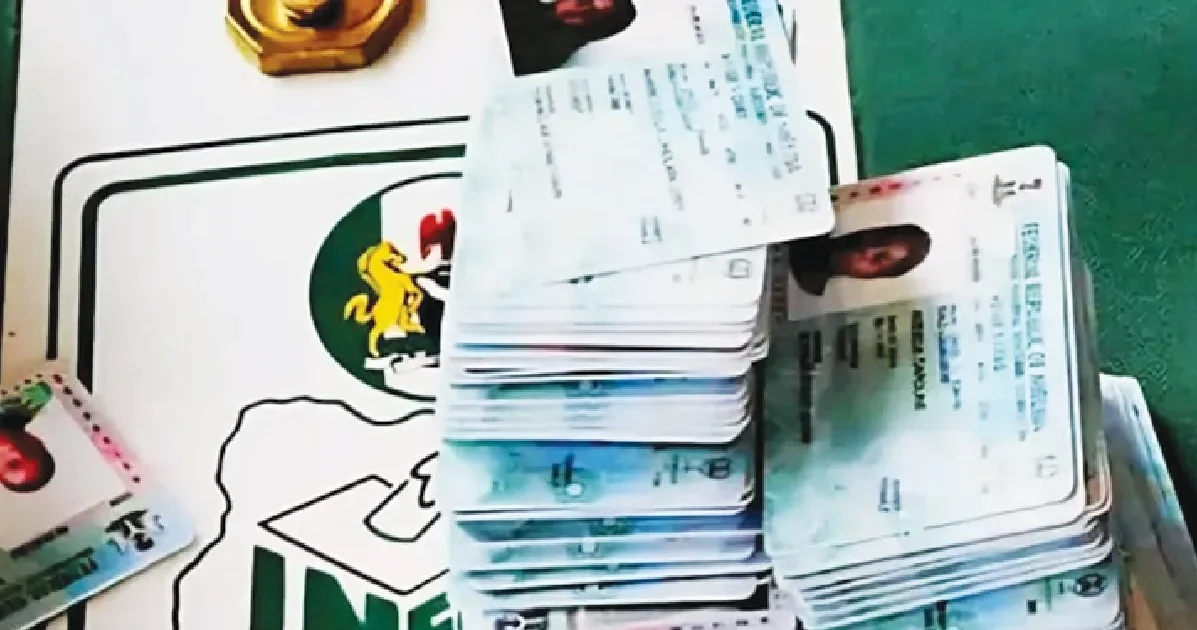
The Independent National Electoral Commission has announced that Permanent Voter Cards for Nigerians who registered between May and July during the recent Continuous Voter Registration exercise are not yet ready, promising to distribute them by the first week of December.
INEC attributed the delay to the ongoing cleanup of the voters’ register, assuring affected registrants that their cards will be ready before the distribution exercise begins.
The Head of Voter Education for the commission in Lagos State, Ayopo Lawal, stated this on Friday while speaking on Citizens Voice 97.1FM, Lagos, ahead of Saturday’s mock election scheduled to hold across 17,656 polling units nationwide.
Lawal noted that PVCs for those who registered between January and April 2026—as well as those who applied for the replacement of lost cards or information updates between August and September 2025—are ready for collection.
She explained, however, that cards for May to July registrants are still being processed and will arrive by the end of November, with distribution expected to commence in the first week of December.
“We always post online the cards that are available. All cards from last year, except transfers, are ready. New registrations, lost cards, and those who want to update their information between August and September are all available. The cards are done in phases.
“From January to April, all new register cards are also available. Others who registered between May and July, their cards are not ready. But they are coming in this month end because of the cleanup. Those are the things delaying the cards and by the first week of December, everything will be ready and we are going to the RAs to share the cards,” she said.
Lawal clarified that the ongoing cleanup of the voters’ register will only affect individuals who registered during the last CVR exercise, stressing that existing voters will not be impacted.
The INEC official also defended the commission’s decision to clean up the register, explaining that the exercise uncovered more than 1.6 million entries comprising invalid registrations, duplicates, and deceased persons, rather than entirely fake voters as widely reported.
She added that the commission had earlier planned a voter revalidation exercise but faced resistance from Nigerians.
Lawal further disclosed that 54 INEC personnel arrested in connection with alleged irregularities involving the voters’ register across 10 states are currently under investigation by security agencies.
Affirming the commission’s commitment to transparency in conducting free and credible elections, she said, “We are not doing this alone; we are working with security personnel, NYSC, and other Nigerians.”
Meanwhile, she noted that Saturday’s mock election is designed to test the commission’s technological improvements and operational procedures ahead of the 2027 general elections.
Lawal added that the exercise will assess the real-time transmission of election results—including in areas with poor network connectivity—as well as improvements in the use of the Bimodal Voter Accreditation System and the INEC Result Viewing portal.
She revealed that the commission has also reduced the voter threshold for deploying additional BVAS machines at polling units from 1,250 to 850 voters to cut waiting times and congestion during accreditation.
The INEC official added that the commission has introduced an electronic result sheet to detect discrepancies between manually recorded results and digitally calculated figures before uploading them.
The commission, she said, will publish a comprehensive report on the mock election after receiving feedback from its officials and independent observers.
