

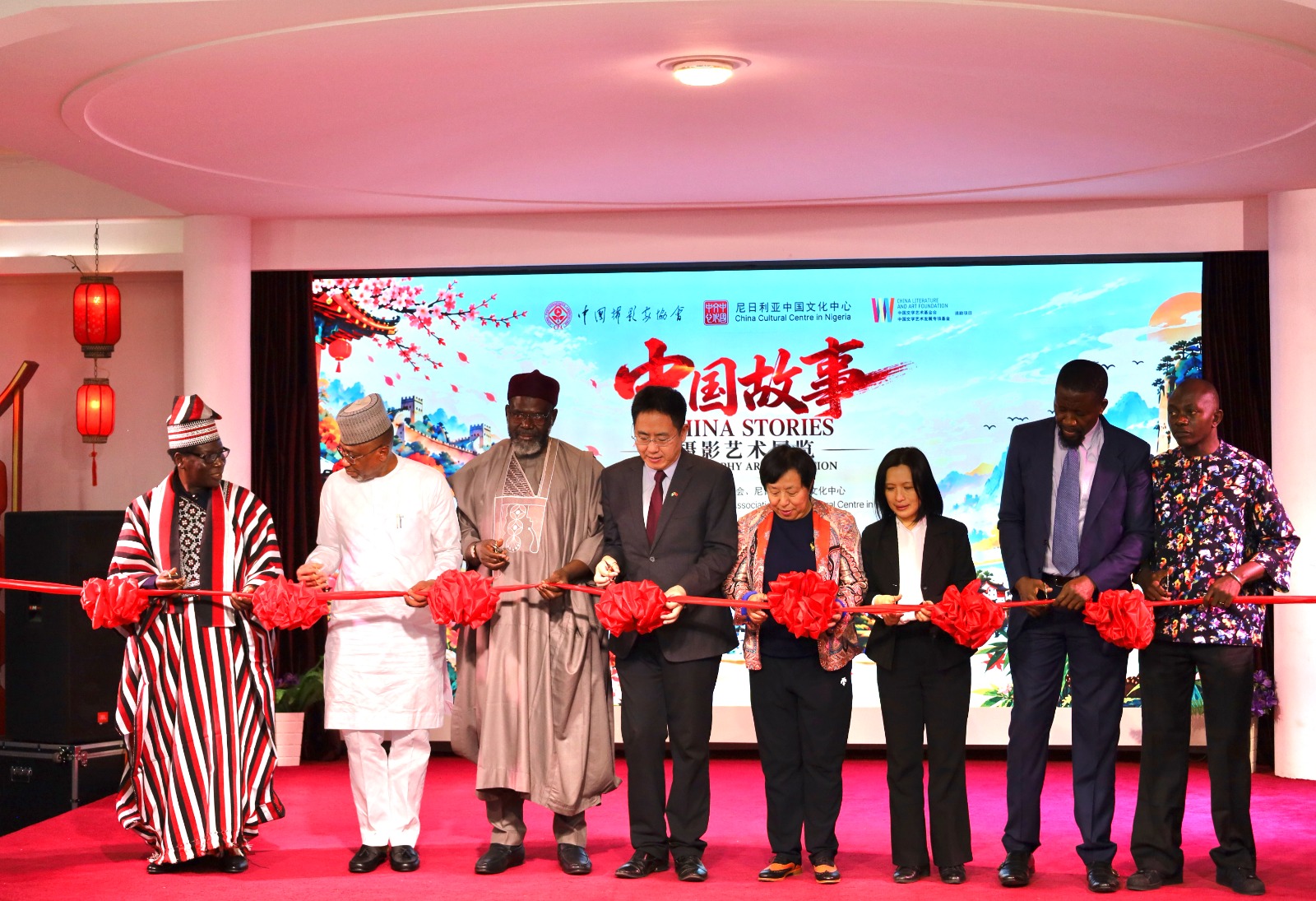
China has called for stronger cultural cooperation with Nigeria and other African countries through photography, artistic exchanges and people-to-people engagement, as both countries seek to deepen mutual understanding and strengthen their longstanding diplomatic relations.
Yang Jianxing, Chinese Cultural Counsellor, made the call at the opening of the “China Stories” Photography Exhibition in Abuja, emphasising the importance of cultural diplomacy in promoting friendship, mutual learning and cooperation between nations.
The exhibition, organised by the China Cultural Centre in Nigeria in collaboration with the China Photographers Association, featured photographic works documenting China’s landscapes, cultural heritage, traditions and socioeconomic development.
Yang said the exhibition was part of efforts to implement the outcomes of the 2024 Beijing Summit of the Forum on China-Africa Cooperation (FOCAC) and advance the Global Civilisation Initiative.
He noted that photography remained an effective instrument for communicating cultural experiences, preserving history and connecting people across linguistic and national boundaries.
“Photography is an art form that transcends language and national boundaries.
“Through its unique visual language, it captures the spirit of an era, conveys human emotions and connects hearts and minds. It serves as an important bridge for promoting mutual understanding and friendship among people from different countries,” he said.
According to him, the exhibition was designed to give Nigerians a deeper appreciation of China’s economic, social and cultural transformation through the perspectives of photographers.
He said China had recorded significant economic and social progress since introducing its reform and opening-up policy in 1978, adding that the country’s development had contributed to global economic growth and helped lift close to 800 million people out of extreme poverty, according to World Bank data.
Read also: Anthropic clinches biggest-ever IPO with $81 billion offering
Yang said China had sustained its pursuit of high-quality development since 2012, with improvements in living standards, education, healthcare, social security, environmental protection and urbanisation.
He explained that the photographs on display provided a visual account of the country’s development trajectory and demonstrated the achievements of Chinese modernisation.
The cultural exhibition also comes as Nigeria and China mark 55 years of diplomatic relations, a partnership Yang described as being built on decades of political support, economic cooperation and cultural exchanges.
He said the relationship had evolved beyond diplomatic engagement to include economic partnerships and growing interactions between the peoples of both countries.
“Over the past 55 years, our two peoples have supported each other politically, pursued mutual benefit and win-win cooperation economically, and learned from and enriched each other culturally. Our relationship has become a fine example of friendly exchanges among countries of the Global South,” he said.
The Chinese diplomat also highlighted China’s decision to fully implement zero-tariff treatment for 53 African countries with which it maintains diplomatic relations, including Nigeria, in May this year.
He said the policy, alongside other initiatives introduced by Chinese President Xi Jinping to strengthen engagement with Africa, demonstrated China’s commitment to expanding cooperation with the continent.
Yang also referenced proposals on addressing Africa’s hotspot issues and cooperation in the mining sector, saying the initiatives reflected China’s respect for African countries’ sovereignty, development priorities and aspirations.
He urged cultural institutions, artists and other stakeholders in Nigeria and China to strengthen collaboration, noting that sustained cultural engagement could complement existing political and economic relations.
He called on both countries to work together in advancing their respective modernisation efforts and building an all-weather China-Africa community with a shared future.
In her goodwill message, Chen Jin, Deputy Secretary-General of the China Photographers Association, said the exhibition featured 40 photographic works showcasing China’s natural landscapes, cultural heritage, traditions and social development.
Chen said the photographs offered Nigerians an opportunity to experience different aspects of Chinese civilisation and identify cultural values shared by both countries.
She listed respect for family, community, cultural heritage, hard work and the preservation of traditions as common values that could provide a foundation for stronger people-to-people relations.
She described photography as a medium capable of communicating emotions, experiences and ideas across geographical and linguistic boundaries, expressing optimism that artistic cooperation between Nigeria and China would expand.
According to her, greater collaboration involving photographers, broadcasters, filmmakers and digital content creators could create opportunities for cultural tourism, knowledge transfer and the development of creative industries in both countries.
She said such partnerships would also provide economic opportunities for practitioners while strengthening the visibility of Nigerian and Chinese cultures internationally.
Also speaking, Charles Ebuebu, Director-General of the National Broadcasting Commission (NBC), described photography as an important tool for documenting history, preserving cultural identities and promoting tourism.
Ebuebu said photographs served as historical records by preserving events, experiences and cultural practices that might otherwise be forgotten.
Read also: Nigeria’s fintech industry faces tighter regulation as Reps pass BOFIA amendment bill
He noted that the images displayed at the exhibition went beyond presenting China’s physical landscapes, as they also captured the country’s history, cultural identity and relationship with nature.
“Ordinarily, they say a picture carries more than a thousand words, but I will say that the memories are in the hundreds of millions at all times because it is that one that has documented history for us,” he said.
The NBC Director-General cited Nigeria’s cultural festivals, including the Argungu Fishing Festival, Durbar and Eyo Festival, as examples of cultural traditions whose histories and significance could be preserved and promoted through photography.
He said documenting such events would help preserve their historical relevance while making them accessible to younger generations and international audiences.
Ebuebu called for more cultural exchanges between Nigeria and China, urging photographers from both countries to travel, document their experiences and share stories about their respective societies.
He said greater interaction between creative professionals could provide opportunities to showcase cultural practices, food, fashion, languages and traditions while correcting misconceptions about both countries.
According to him, sustained exchanges would allow Nigerians and Chinese citizens to develop a better understanding of each other’s societies beyond the information available through conventional media.
Similarly, Osaze Efe, Coordinator of the Photographers Association of Nigeria, said photography offered a universal language through which people could explore unfamiliar cultures, understand different perspectives and appreciate their shared humanity.
Efe, who also represented the Abuja International Photo Festival, said the organisation had built a network of more than 5,000 creatives across Nigeria.
He disclosed that the festival recently marked its 10th anniversary, attracting photographers from 42 countries, including participants from China.
He said the participation of Chinese photographers in previous editions reflected the existing relationship between the photography communities of both countries and provided a platform for expanding artistic collaboration.
“Photography is a universal language. It allows us to travel beyond borders, encounter unfamiliar cultures, understand different perspectives and discover shared humanity that connects us all,” he said.
Efe said exhibitions such as “China Stories” provided Nigerians with an opportunity to understand China through the experiences and perspectives of its photographers.
He noted that photography should not be viewed solely as an artistic expression but also as an instrument for cultural diplomacy, education, dialogue and international cooperation.
He expressed optimism that the exhibition would encourage stronger partnerships between Nigerian and Chinese photographers, cultural institutions and creative communities, adding that sustained collaboration could further strengthen cultural relations between the two countries.


