

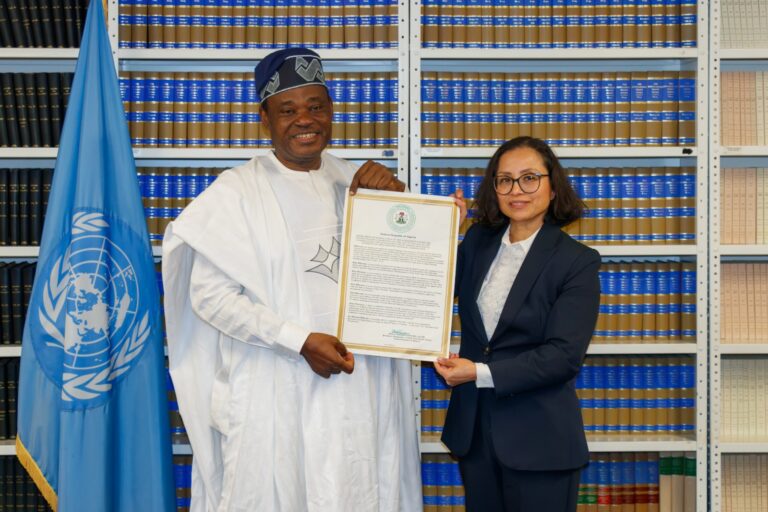
Nigeria has become the 108th country to ratify the United Nations (UN) Agreement on Marine Biological Diversity of Areas Beyond National Jurisdiction (BBNJ), in a move aimed at strengthening its participation in the global blue economy.
The country’s Permanent Representative to the UN, Ambassador Ibrahim Jimoh, deposited Nigeria’s instrument of ratification at the UN Headquarters in New York on Tuesday, after President Bola Tinubu personally signed the instrument.
The instrument was received by Evelyn Sánchez, Officer-in-Charge of the UN Treaty Section, who confirmed that Nigeria had become the 108th party to the agreement.
Nigeria eyes opportunities in its maritime resources
Jimoh said the administration was seeking to unlock the economic potential of Nigeria’s maritime domain as global attention increasingly shifts towards ocean resources.
- “The whole idea is President Tinubu’s desire to develop the blue ocean economy,” he said.
The ambassador noted that Nigeria’s maritime ambitions extended beyond the conventional 200-nautical-mile limit of its continental shelf, following recommendations by the UN Commission on the Limits of the Continental Shelf on Nigeria’s submission for an extended continental shelf.
The Presidency had described the additional area, estimated at approximately 16,300 square kilometres, as roughly five times the size of Lagos State, with potential deposits of hydrocarbons, gas, solid minerals and sedentary marine species.
However, Jimoh said exploiting these opportunities would require substantial investment in geophysical equipment, ocean mapping, scientific surveys and technologies to identify the resources beneath the country’s maritime domain.
- “We have to buy geophysical equipment to be able to know what is in all this sea, and then we can appropriately tackle those resources. I think that’s the future; that’s the wealth of tomorrow,” he said.
He added that the administration intended to combine maritime opportunities with science, technology, investment and international cooperation to diversify the economy beyond traditional onshore resources.
What the UN ocean treaty covers
The BBNJ Agreement establishes an international framework for the conservation and sustainable use of marine biological diversity in areas beyond national jurisdiction.
Its key provisions cover marine genetic resources, area-based management measures, environmental impact assessments, capacity building and the transfer of marine technology.
Jimoh stressed that Nigeria’s rights over its extended continental shelf were legally distinct from the BBNJ Agreement, which focuses on biodiversity conservation and sustainable use in areas beyond national jurisdiction.
He said Nigeria intended to participate actively in implementing the agreement through cooperation with other countries.
- “Nigeria’s participation will be very cooperative and collaborative among many countries in ensuring that the blue ocean economy is actually of benefit to mankind,” he said.
Nigeria’s blue economy plans
Nigeria’s ratification of the BBNJ Agreement comes amid other government efforts to unlock the economic potential of its maritime resources.
- In May 2024, Nairametrics reported that Nigeria had secured recommendations from the UN Commission on the Limits of the Continental Shelf for an additional 16,300 square kilometres of continental shelf, an area described as roughly five times the size of Lagos State.
- Beyond securing recognition for its extended continental shelf, the Federal Government has also explored ways to harness resources beneath the ocean floor. In September 2024, the government announced plans to explore deep-seabed mining for solid minerals and other resources as part of efforts to diversify the economy.
The government has also reported growing revenue from the maritime sector. In April 2026, the Minister of Marine and Blue Economy, Adegboyega Oyetola, disclosed that the ministry generated N1.83 trillion in revenue in 2025, up from N700.79 billion in 2023, representing a 160% increase. The ministry has set a target of N2 trillion in annual revenue by 2027.
