

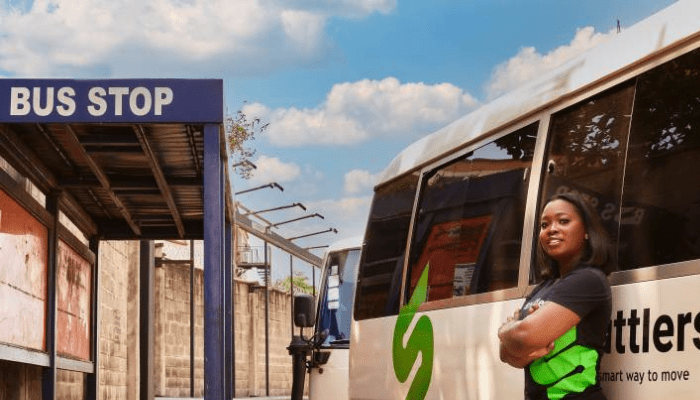
For nine months starting in September 2025, a 32-seater electric bus hummed along the gridlocked arteries of Lagos, Nigeria’s commercial capital. Operated by mobility startup Shuttlers in partnership with electric-vehicle infrastructure provider SAGLEV, the pilot was designed to test whether zero-emission mass transit could survive the punishing economics of sub-Saharan Africa’s largest megacity.
The technology held up. The unit economics, however, hit a familiar wall.
“We validated that EV buses can work on our routes,” said Akachukwu Okafor, co-founder and chief technology officer of 10-year-old Shuttlers, during a recent conversation on the stubborn bottlenecks of African urban mobility. “The challenge is that commuters won’t pay a premium—they demand competitive pricing. At our current fare points, a brand-new electric bus takes at least six to seven years just to break even.”
That six-year horizon exposes the central fault line in African mass transit: the collision between high upfront capital costs and price-sensitive commuters. Across the continent, transport accounts for 73 percent of the infrastructure financing gap, yet private investors deployed just $4 billion across 46 transport-infrastructure deals between 2012 and 2023.
Nowhere is that capital deficit felt more acutely than in Lagos, a sprawling metropolis of more than 22 million people that houses roughly 40 percent of Nigeria’s registered vehicles. Residents lose an average of 30 hours a week, nearly three hours a day to traffic congestion. Across sub-Saharan Africa, workers spend roughly 57 percent of their income just getting to and from work. With Africa’s urban population projected to reach 1.5 billion by 2050, the toll on productivity, public health, and air quality—already more than five times the recommended limits in Lagos, with a traffic fatality rate triple that of most European cities- is mounting rapidly.
An asset-light pivot
When Lagos launched its state-backed Bus Rapid Transit system in March 2008 under then-Governor Babatunde Fashola, it signalled an ambitious push to modernise a fragmented transit sector dominated by informal minibuses. Shuttlers, founded a decade ago to digitise corporate staff buses, initially tried owning its own fleet. It quickly abandoned the approach.
Managing mechanics, spare parts, and vehicle depreciation proved a distraction from what Okafor calls the company’s real edge: software, route optimization, and demand aggregation. Today, Shuttlers operates an asset-light marketplace that has scaled from a handful of vehicles to more than 400 buses across its network.
Third-party fleet operators supply the vehicles and handle maintenance, while Shuttlers assumes full operational control—enforcing driver training, real-time GPS tracking, and standardized schedules running from 5:30 a.m. to 10:00 p.m., with select 24-hour shifts for corporate clients. Onboarding a new vehicle onto the platform, a process that once took four days of manual vetting, now takes less than 10 minutes.
To insulate commuters from Nigeria’s volatile fuel prices and macroeconomic swings, Shuttlers has built direct supply relationships with filling stations and deliberately absorbs short-term margin compression rather than passing sudden price hikes onto riders.
“We weather a drop in our gross margin to provide pricing predictability to customers, and we share that cost with our bus partners,” Okafor said. In return, fleet owners receive guaranteed revenue streams backed by enterprise contracts and scheduled consumer bookings.
Read Also: Shuttlers moves beyond bus stops with new door-to-door car service

Growth beyond borders
That dual-engine model—pairing direct-to-consumer commuter routes with long-term corporate staff contracts—has helped Shuttlers hedge against both institutional client churn and retail demand fluctuations. Since 2021, the company has doubled its revenue year over year and is now approaching profitability, though Okafor declined to disclose specific figures.
Over the next two years, Shuttlers is concentrating on deepening its footprint in Nigeria and Abidjan, Côte d’Ivoire, its first Francophone market. Expanding into Abidjan offered a stark contrast to Nigeria’s regulatory patchwork, where transport permits must be negotiated state by state. Côte d’Ivoire’s centralized framework and nationwide licensing allowed Shuttlers to stress-test its playbook in a new language and regulatory regime.
“Most people would have turned it down because they speak French,” Okafor said. “Abidjan met every criterion for a city that needs our service, and it lets us prove we can build a global company that thrives in any market.”
Mass transit needs patient capital
Still, scaling mass transit in West Africa requires more than clean code. A single brand-new Toyota Coaster bus costs between 100 million and 150 million naira, and traditional commercial lenders frequently demand real estate or cash collateral on top of the vehicle itself.
To unlock fleet growth without bloating its own balance sheet, Shuttlers is piloting an asset-financing subsidiary to help top-performing fleet partners acquire buses. Long term, however, Okafor argues that transforming African transit requires a different class of backer: impact funds, development finance institutions, and value investors comfortable with seven- to 10-year horizons.
“Investors recognise that solving this creates a massive first-mover advantage,” Okafor said. “Whoever cracks mass transit at scale captures near-monopoly network value.”
Read Also: Five transport projects set to transform mobility in Nigeria
Eyes on the rail tracks
Even as it refines its bus network, Shuttlers is looking beyond asphalt. In Lagos, where the state government is expanding its urban rail network and developing frameworks for private-sector participation, Shuttlers already operates first- and last-mile feeder pods connecting commuters to train stations.
Now, the company is in early-stage discussions with authorities to participate directly in the rail economy—potentially operating passenger coaches through joint ventures or special-purpose vehicles where institutional investors own the rolling stock, and Shuttlers manages daily operations.
“Our preference is direct operational control, just like we have with buses today,” Okafor said. “Control doesn’t have to mean ownership. If an entity wants to buy rail coaches without the headache of running them, partnering with an operator that already moves thousands of people on schedule every day is how that vision scales.”
“Right now we are still at the ideation stage where we are exploring all the options and the pros and cons and what to represent.”


