

Okomu Oil Palm Company Plc’s rising production volumes are failing to translate into stronger earnings as falling selling prices, higher input costs and expensive third-party fruit purchases squeeze profitability.
CardinalStone has cut its 12-month target price for the agricultural company to N721.25 from N1,066.34, representing a 32.4 percent reduction and implying a 36.57 percent downside from its reference share price of N1,137.10.
It maintained its SELL recommendation.
CardinalStone lowered its revenue growth expectations and raised its cost assumptions following Okomu’s nine-month 2026 performance and subsequent discussions with management.
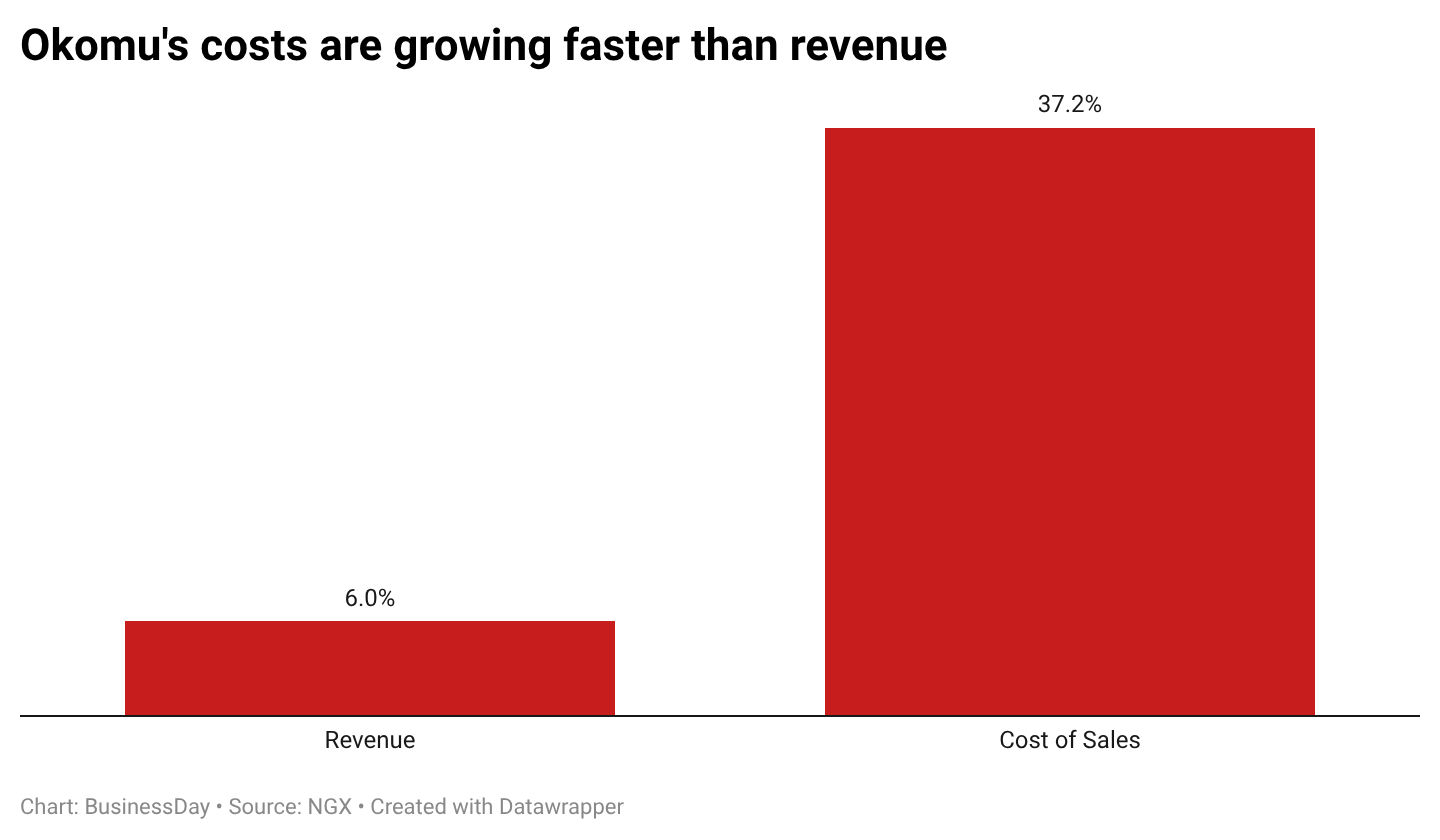
Okomu reported a 6 percent year-on-year increase in revenue to N184.4 billion in the nine months to September, supported by a 30 percent increase in crude palm oil (CPO) volumes.
However, the higher volumes came alongside an approximately 18 percent decline in realised selling prices as domestic palm oil prices faced pressure from illegal imports and changes in the import tariff environment.
The price decline has weakened the relationship between production growth and revenue expansion, prompting CardinalStone to lower its average FY2026 revenue per tonne forecast to N1.8 million from N2 million previously.
The cost of securing raw materials is creating another challenge. Okomu purchased 73,183 tonnes of fresh fruit bunches (FFB) from third parties during the review period, compared with CardinalStone’s estimated 24,000 tonnes in the corresponding period of 2025.
The research firm estimates that producing FFB internally costs approximately N130,000 per tonne, compared with N340,000 for third-party purchases.
“Each additional tonne of bought-in fruit adds revenue but dilutes margins,” CardinalStone said, highlighting the profitability trade-off behind the company’s reliance on external supplies.
The firm attributed the increased purchases partly to Okomu running out of land for further planting, limiting its ability to expand internally generated supplies to match processing demand.
Read also: Okomu’s half-year profit falls 16% on weaker sales
The pressure was reflected in cost of sales, which increased 37.2 percent year-on-year in the nine months, significantly above CardinalStone’s 17.7 percent expectation.
Consequently, the research firm lowered its FY2026 revenue forecast to N203.2 billion from N206.2 billion previously and projected profit after tax to decline 17.6 percent to N47.8 billion.
It also reduced its average operating margin forecast over the five-year projection period to 46.8 percent from 52.8 percent, reflecting weaker selling prices, higher fertiliser and energy costs and increased reliance on third-party fruit purchases.
However, the outlook improves in 2027 as global palm oil prices are expected to strengthen.
CardinalStone expects crude palm oil prices to increase by 10 to 15 percent in dollar terms, supported by tighter supply conditions in Indonesia and Malaysia.
It projects Okomu’s profit after tax to rebound 33.8 percent to N63.9 billion in 2027, with expected CPO production rising to approximately 103,042 tonnes.
Read also: Inside Presco, Okomu’s N202bn earnings spree
Dividend expectations have also been revised downwards. CardinalStone cut its FY2026 dividend forecast to N26 per share from N54.53, implying a 51.9 percent payout ratio, compared with a three-year average of 87.3 percent.
The company closed at N1,137.10 in the research report’s valuation reference, giving it a market capitalisation of approximately N1.08 trillion.
Its valuation also remains elevated, trading at a trailing price-to-earnings ratio of 26.26 times against a peer average of 11.68 times.
For CardinalStone, the combination of weaker pricing, rising procurement costs, and a relatively expensive valuation leaves limited room for near-term upside.


