

…Nigeria continues to rely on imports
Tax incentives introduced by the Federal Government to stimulate Nigeria’s pharmaceutical industry have yet to translate into cheaper medicines or significant growth in domestic production, leaving consumers exposed to rising drug prices as the country remains heavily dependent on imports.
In 2024, President Bola Tinubu signed an Executive Order removing tariffs, excise duties and Value Added Tax (VAT) on selected pharmaceutical machinery and raw materials.
The incentives, which took effect on October 11 for an initial two-year period, were designed to reduce manufacturers’ production costs, attract investment in local factories and ultimately make medicines more affordable.
The intervention followed the exit of several multinational pharmaceutical companies, including GlaxoSmithKline (GSK) and Sanofi-Aventis, from Nigeria, a development that contributed to higher prices of several essential medicines.
However, with the two-year implementation period approaching its end, findings by BusinessDay show that billions of naira in tax waivers have yet to deliver significant improvements in local pharmaceutical production or provide meaningful price relief for consumers.
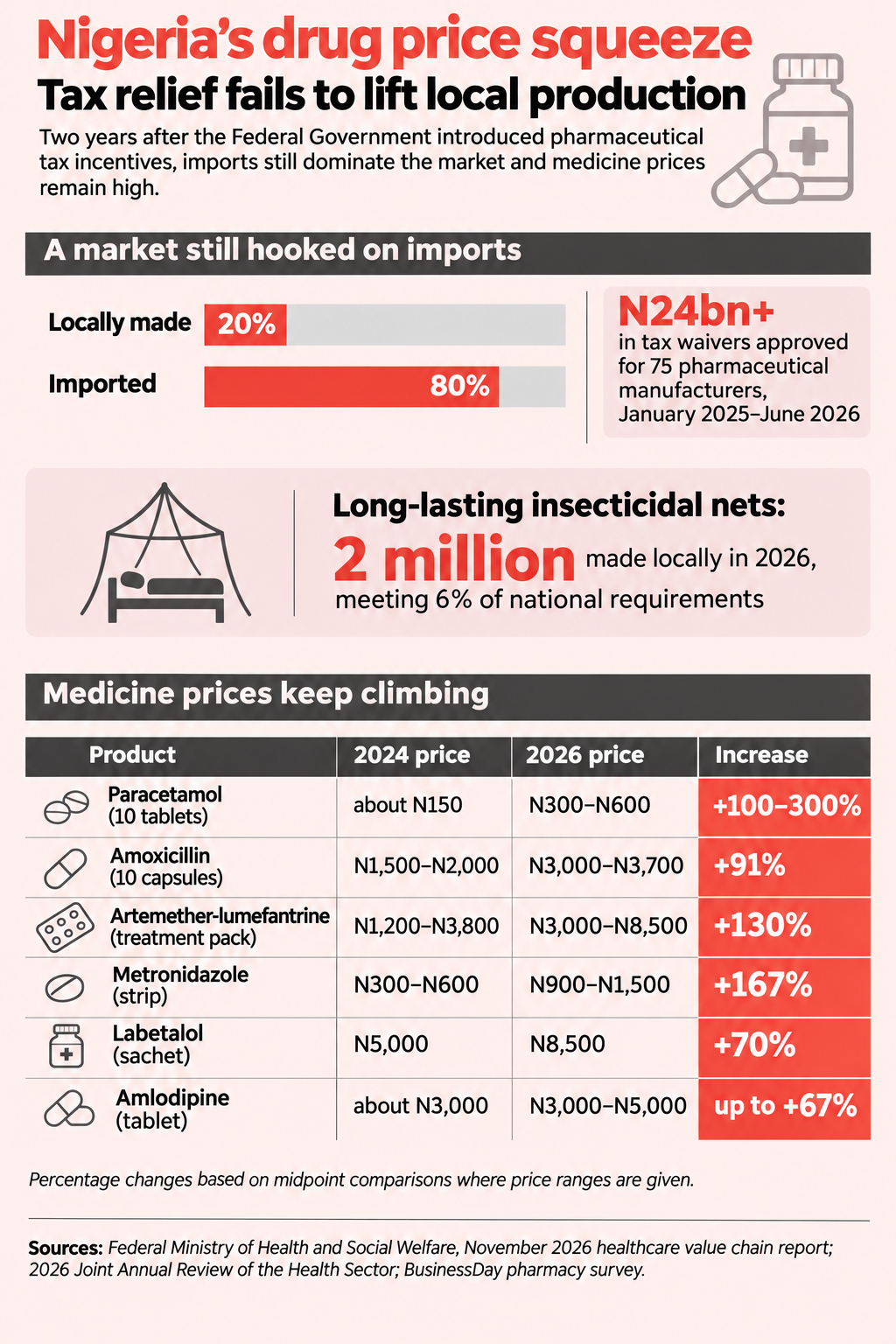
A November 2026 report on the healthcare value chain by the Federal Ministry of Health and Social Welfare shows that locally manufactured products account for just 20 percent of the market, compared with 80 percent for imports.
The report said the Federal Government approved more than N24 billion in tax waivers for 75 pharmaceutical manufacturers between January 2025 and June 2026.
Despite the intervention, domestic manufacturing remains particularly weak in high-value segments such as diagnostics, vaccines, biopharmaceuticals and medical devices, limiting Nigeria’s ability to reduce its dependence on imported healthcare products.
The report estimated Nigeria’s healthcare products market at between $4 billion and $6 billion. Therapeutic pharmaceuticals account for the largest segment, valued at $1.7 billion to $2.2 billion, but local manufacturers supply only 15 to 35 percent of demand.
Non-therapeutic consumer health products, valued at $1.1 billion to $1.3 billion, have a similar domestic production share of 15 to 35 percent.
Local production accounts for just 0 to 2 percent of diagnostics, while the country has no domestic production of biopharmaceuticals, including vaccines. Domestic production of medical devices also stands at zero, according to the report.
Read also: FG grants pharma manufacturers N24bn tax waivers to boost local production
Animal health products have a local production share of only 2 to 5 percent, while medical consumables and equipment record domestic production levels of 15 to 35 percent.
There have, however, been some improvements in selected areas.
Nigeria recorded its first local production of long-lasting insecticidal nets during the period, manufacturing two million nets in 2026, compared with none in 2025, according to the 2026 Joint Annual Review of the Health Sector.
The output met an estimated 6 percent of national requirements following the commissioning of two local manufacturing facilities.
The number of products transitioned from importation to local production also increased from 49 in 2025 to 51 in 2026, the report showed.
Drug prices show no relief
While the government has reported lower production costs for manufacturers, consumers are yet to experience corresponding reductions in medicine prices.
A BusinessDay survey of pharmacy outlets found that prices of commonly used medicines have either remained elevated or increased further since 2024.
A strip of 10 paracetamol 500mg tablets, commonly used to relieve pain and reduce fever, which sold for about N150 in 2024, now costs between N300 and N600. This represents an increase of between 100 and 300 percent, with the midpoint of the current price range indicating a 200 percent rise.
Amoxicillin, an antibiotic used to treat bacterial infections, has also become more expensive. A pack of 10 capsules of 500mg, which sold for between N1,500 and N2,000 in 2024, now costs between N3,000 and N3,700 in the surveyed outlets. A comparison of the midpoint prices indicates an increase of about 91 percent.
The cost of malaria treatment has followed a similar trend. Artemether-lumefantrine, a combination medicine used to treat uncomplicated malaria, rose from between N1,200 and N3,800 per treatment pack in 2024 to between N3,000 and N8,500 in 2026. This represents an estimated 130 percent increase based on the midpoints of the price ranges.
Metronidazole, an anti-infective medicine used to treat certain bacterial and parasitic infections, has increased from between N300 and N600 per strip in 2024 to between N900 and N1,500. This represents an estimated 167 percent rise.
The increases are also affecting people managing long-term health conditions.
Read also: Edo in talks with Chinese investors to revive pharmaceutical company
Labetalol, a medicine used to treat high blood pressure, has risen from about N5,000 per sachet to N8,500, an increase of 70 percent.
Amlodipine, prescribed for high blood pressure and certain heart-related conditions, has also become more expensive. One pharmacy survey put its price at between N3,000 and N5,000, compared with about N3,000 in 2024, indicating an increase of up to 67 percent.
Chimezie Amadi, a local pharmaceutical manufacturer and owner of Soha Pharmaceuticals in Lugbe, Abuja, said medicine prices had not declined despite the government’s intervention. While some products had remained relatively stable over the past year, others had become more expensive.
“For instance, Emzor paracetamol has been N300 per card for a year now. It used to be less. So prices have not reduced; some are stable, while others are increasing,” he said.
For some Nigerians, the rising cost of medicines has forced difficult choices, including switching to cheaper alternatives or delaying treatment.
Adaku James, a resident of Abia State, said she recently abandoned her preferred pain medication after being presented with a bill of N4,500.
“I recently went to buy pain relief, and they handed me a bill of N4,500. I don’t spend more than N2,000 anytime I need pain medication, so I had to go for a cheaper option of N1,300, but it’s not as effective,” she said.
Dennis Tagwai, a security officer at an Abuja estate, said the rising cost of medicines had made him reluctant to buy drugs unless an illness became severe enough to prevent him from working.
“Paracetamol and Panadol are the only drugs that one can buy now. Even vitamin C is expensive. I don’t buy drugs, except when the sickness has become serious and won’t allow me to work. Most times, if I sleep well, I’ll get myself,” he said.
Manufacturers cite implementation bottlenecks
While pharmaceutical manufacturers and other industry stakeholders have welcomed the government’s incentives, they say implementation delays, bureaucratic bottlenecks and high operating costs continue to limit their impact.
A study by the National Institute for Pharmaceutical Research and Development (NIPRD) on the implementation and impact of the Executive Order found that fewer than 40 percent of surveyed manufacturers reported tangible improvements in production capacity, innovation or investment.
Although awareness of the policy stood at 92.1 percent, only 53.1 percent of respondents had attended policy-related seminars or training.
The study identified excessive bureaucracy as a major implementation barrier, with 71.9 percent of respondents citing it as a challenge. Another 70.3 percent pointed to inadequate training.
Despite these difficulties, some manufacturers say the tax relief has reduced their operating costs.
Read also: Experts urge Nigeria’s pharmaceutical industry to look beyond domestic market
Lanre Shittu, chairman of HMA Medicals Limited, said his company had saved hundreds of millions of naira through the waivers.
“The policy is beneficial, but its impact would depend on continuity and improvements in implementation,” he said.
However, Shittu said manufacturers continued to contend with high operating costs, double-digit interest rates, expensive energy and limited access to loans and capital, all of which increase the cost of producing medicines.
Andrew Chimezie of DCL Laboratories also described the policy as beneficial but urged the government to remove bureaucratic bottlenecks, particularly those associated with clearing imported production inputs.
Some pharmaceutical companies have also reported improved financial performance.
Neimeth International Pharmaceuticals Plc said the incentives helped reduce production costs and supported its return to profitability in 2025. Fidson Healthcare Plc also reported a 61 percent increase in profit after tax to N9.31 billion in 2025.
Manufacturers seek policy continuity
With the initial two-year implementation period approaching its end, manufacturers are urging the Federal Government to sustain the incentives to give the industry more time to expand production capacity and deepen investment.
Oluwatosin Jolayemi, chairman of the Pharmaceutical Manufacturers Group of the Manufacturers Association of Nigeria, said extending the policy would allow manufacturers to consolidate existing gains and undertake further investments.
He said the industry needed policy consistency and a predictable investment environment to overcome persistent challenges, including high energy and production costs, supply chain disruptions, port inefficiencies, limited access to long-term capital and market access constraints.


