

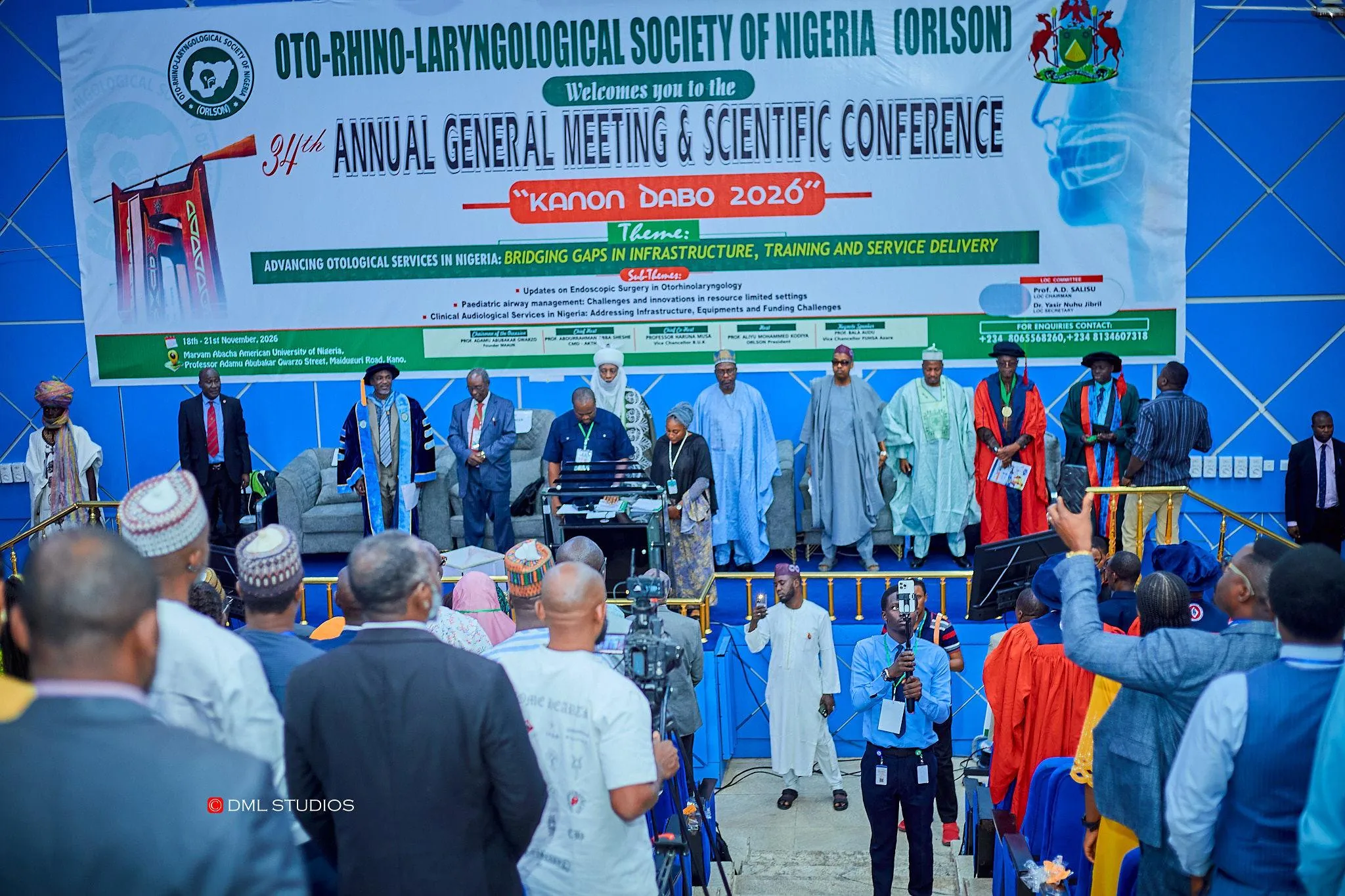
The Otorhinolaryngological Society of Nigeria (ORLSON) has called for urgent government intervention to address critical gaps in ear and hearing healthcare services across the country, citing inadequate infrastructure, shortage of specialists, rising cost of treatment and limited access to modern medical technologies.
The call formed part of resolutions reached at the end of the Society’s 34th Annual General Meeting and Scientific Conference held from November 18 to 21 at the Maryam Abacha American University of Nigeria (MAAUN), Kano.
The resolutions are contained in a communique issued at the end of the conference and signed by ORLSON outgoing President, Professor Aliyu Mohammed Kodiya, and the outgoing Secretary, Dr Enema J. Amodu.
The conference, which was held under the theme, “Advancing Otological Services in Nigeria: Bridging Gaps in Infrastructure, Training and Service Delivery,” brought together ear, nose and throat (ENT) specialists, resident doctors, audiologists, nurses, speech and language professionals, researchers, academics, healthcare administrators, development partners and industry stakeholders from within and outside Nigeria.
A communiqué issued at the end of the four-day gathering highlighted growing concerns about the burden of preventable ear diseases and hearing loss in Nigeria and emphasized the need for a coordinated national response to improve access to quality ear and hearing care services.
Wide-ranging deliberations
The conference featured scientific presentations, panel discussions, workshops and stakeholder engagements that focused on various aspects of otorhinolaryngology, including otology, audiology, paediatric ENT practice, rhinology, laryngology and head and neck surgery.
Participants examined challenges confronting hearing healthcare services in Nigeria and reviewed recent developments in clinical practice, training and research.
As part of activities marking the conference, delegates paid courtesy visits to the management of the Maryam Abacha American University of Nigeria, Aminu Kano Teaching Hospital and the Emir of Kano.
The event was officially declared open by a representative of the Kano State Government, while participants also reviewed the progress of the professional body and conducted elections that produced a new National Officers Committee.
ORLSON further used the occasion to showcase activities of its Abuja Secretariat and highlight ongoing efforts aimed at strengthening its digital platforms and institutional structures.
Infrastructure deficit remains major challenge
The society ORLSON seeks improved hearing care, specialist training as ENT experts meet in Kano that despite increasing demand for hearing and ENT services, many healthcare facilities across the country still lack adequate infrastructure and equipment needed for effective diagnosis, treatment and rehabilitation of patients.
Delegates expressed concern that several hospitals are operating without modern audiological equipment, advanced diagnostic tools and specialised surgical facilities required to manage complex ENT conditions.
According to the communiqué, the shortage of ENT specialists and audiology professionals, coupled with their uneven distribution across the country, continues to create significant barriers to access, particularly for people living in rural and underserved communities.
The society noted that many patients must travel long distances before receiving specialist attention, often leading to delayed diagnosis and treatment.
Cost of hearing care beyond reach of many Nigerians
The conference also raised concern about the high cost of hearing healthcare services, hearing aids, cochlear implants and other assistive devices.
Participants observed that many Nigerians living with hearing impairment are unable to access essential interventions because of financial constraints and inadequate health insurance coverage.
The experts stressed that hearing loss remains a major public health issue whose social, educational and economic consequences are often underestimated.
They warned that failure to address barriers to hearing care could result in reduced quality of life, impaired educational outcomes among children and diminished productivity among adults.
Shortage of training opportunities
Another major concern highlighted by the conference was the limited availability of training opportunities and facilities for doctors and other healthcare professionals seeking specialization in otology and related fields.
The society observed that existing residency and subspecialty training programmes require strengthening to meet the growing demand for highly skilled personnel.
Participants also identified gaps in mentorship, research opportunities and access to modern technologies needed to train the next generation of ENT specialists and hearing care professionals.
The conference further expressed concern over challenges associated with paediatric airway management and the need for more specialized services to cater to children with complex airway conditions.
Slow adoption of advanced surgical techniques
The communiqué noted that while significant advances have been made globally in ENT and hearing care, the adoption of modern surgical techniques and innovative treatment approaches remains limited in many healthcare centres across Nigeria.
Experts at the conference attributed this situation to inadequate infrastructure, insufficient training opportunities and funding constraints.
They stressed the need to promote evidence-based medical practices and encourage the wider use of advanced procedures capable of improving patient outcomes.
Call for comprehensive reforms
To address identified challenges, ORLSON urged federal and state governments to prioritize ear and hearing healthcare within national and sub-national health plans.
The society recommended the establishment of regional centres of excellence across the country to serve as hubs for specialist care, training, research and innovation.
It also called for substantial investment in audiology infrastructure and equipment in both teaching hospitals and other healthcare facilities.
The conference urged policymakers to expand health insurance coverage to include hearing care services and assistive hearing devices, thereby reducing the financial burden on patients and their families.
According to the society, such interventions would significantly improve access to essential hearing services and help reduce the burden of untreated hearing loss.
Integration into primary healthcare
Participants stressed the importance of integrating ear and hearing care into the primary healthcare system to facilitate early detection and management of hearing disorders.
The society advocated the expansion of hearing screening programmes for newborns, school children and other vulnerable populations as part of broader preventive healthcare measures.
According to the communiqué, early identification and intervention remain critical for improving outcomes among children with hearing impairment and other ear-related conditions.
The society noted that many hearing disorders can be effectively managed or prevented if detected at an early stage.
Strengthening manpower and research
ORLSON further called for expansion of training and residency capacities across accredited institutions to increase the number of specialists available to meet growing healthcare needs.
The conference advocated policies aimed at improving recruitment, retention and equitable distribution of ENT specialists and allied professionals throughout the country.
It also emphasized the need for stronger collaboration among institutions, researchers and policymakers to generate data that can inform evidence-based decision making.
Participants urged governments, development partners and funding agencies to support collaborative research initiatives focused on ear and hearing health.
The society said improved data systems, governance mechanisms and research funding would be essential for tracking progress and addressing emerging healthcare challenges.
Digital transformation and institutional strengthening
Beyond clinical issues, the conference emphasized the importance of strengthening the professional body through continuity in leadership, accountability, digital transformation, advocacy and curriculum development.
Delegates reiterated the need for sustained efforts to improve institutional capacity and ensure that the society remains responsive to evolving healthcare demands.
The conference also highlighted the role of digital platforms in enhancing communication, knowledge sharing, professional collaboration and public engagement.
Roadmap for implementation
To ensure that conference resolutions translate into measurable outcomes, ORLSON proposed the development of a time-bound implementation framework.
The roadmap, according to the communiqué, will clearly define responsibilities, funding opportunities, monitoring indicators and reporting timelines for key interventions.
Participants stressed that sustained follow-up and collaboration among stakeholders would be necessary for achieving meaningful improvements in ear and hearing healthcare services nationwide.
Appreciation and tribute
The society expressed appreciation to the Kano State Government, the Emir of Kano, the Maryam Abacha American University of Nigeria, Aminu Kano Teaching Hospital, Bayero University Kano, conference sponsors, delegates and other stakeholders who contributed to the success of the event.
The conference also paid tribute to the late Dr. (Col.) Andrew O. Imogu for his contributions to the development of otorhinolaryngology in Nigeria.
Commitment to improved healthcare
At the end of the conference, ORLSON reaffirmed its commitment to promoting equitable access to quality ENT, ear and hearing care services across the country.
The society pledged to continue providing professional leadership, supporting advocacy efforts, encouraging research and fostering partnerships aimed at strengthening otorhinolaryngological services in Nigeria.
It maintained that bridging existing gaps in infrastructure, manpower development and service delivery remains essential to improving health outcomes for millions of Nigerians affected by ear and hearing disorders.
UPDATE NEWS:
Nigerians can now invest ₦2.5 million on premium domains and profit about ₦17-₦25 million. All earnings paid in US Dollars. Rather than wonder,
click here to find out how it works.
