

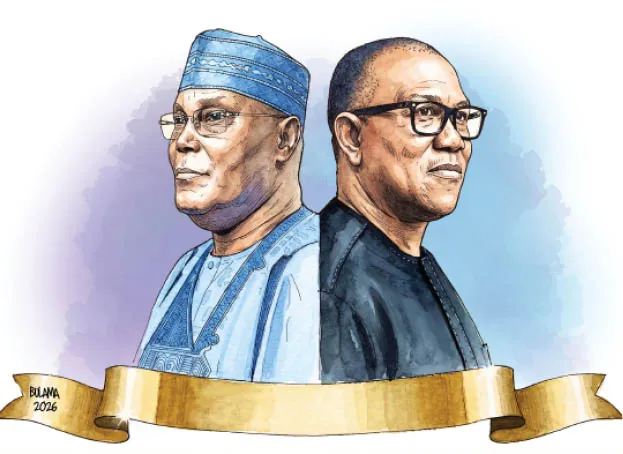
Presidential candidates of the African Democratic Congress (ADC), Alhaji Atiku Abubakar, Nigeria Democratic Congress (NDC), Peter Obi, Allied Peoples Movement (APM), Seyi Makinde, Peoples Redemption Party (PRP), Donald Dukea and the Social Democratic Party (SDP), Adewole Adebayo, would be meeting in Abuja on Monday.
The agenda, as widely known, is to forge collaboration among the opposition figures in Nigeria ahead of the January 16, 2027 presidential election, with a view to making them rally round a single candidate. President Bola Ahmed Tinubu is pulling all stops to ensure that he returns.
The Monday meeting promises to be a critical event ahead of the 2027 elections as its conclusions would define the shape, colour and texture, as well as increase the tempo and accelerate the pace of activities towards the elections.
Our correspondents observed that initially, not much significance was attached to the bid by the opposition to work towards forging a common front due to the ambitions of the leading candidates. Gradually, however, after a series of letdowns, it is becoming clearer that they may be ready to work out something, even if it is not in the mode of the 2015 approach adopted by the then opposition leaders and some members of the then ruling party, the Peoples Democratic Party (PDP) in what later culminated in the formation of the All Progressives Congress (APC).
Sources in the opposition parties said different strategies were being worked out, which may not necessarily require any of the candidates stepping down. The source said that rather than the known method, they would be encouraged to go into the elections on their separate platforms while concentrating on their regions of strength in order to loosen the grip of the ruling party in many areas so as to prevent a clear winner from emerging in the first ballot.
Gov Makinde gave hint of this when he explained recently that the coming together of the leading opposition figures would not be like the full merger that produced the APC in the run-up to the 2015 polls.
He described it as a loose working arrangement, not a formal coalition of parties.
“There will be an arrangement between myself, Atiku and Obi to stop President Tinubu from winning the 2027 presidential election, but it won’t be a coalition like the one Tinubu led in 2015 when opposition parties merged before the 2015 general elections,” he revealed.
It was learnt that this is because asking candidates to step down would bring up many fresh issues among their supporters, most of which may not be resolved before the elections.
Other sources said the coalition was still exploring the option of a single candidate and that the options had been narrowed down to two: Atiku Abubakar and Peter Obi. This is said to be because both Makinde and Duke have given indications that they are not averse to lining up behind whoever emerges as the consensus candidate among them.
Weekend Trust gathered that the party organs of all the candidates are fully in support of the negotiations. However, initially, there was a gap in some of the parties like the NDC, where there was a disagreement between the Obi/Kwankwaso group and the party leadership.
Sources said another huge challenge was how to accommodate the interests of vice presidential candidates in the overall alliances, noting that at the time the APC succeeded in putting its house together in 2015, primaries were yet to be conducted; hence it was easier to bring the aspirants together to contest under one platform, with the agreement that any of them that won would receive the cooperation of all.
But now, apart from the interests of the presidential candidates, those of the running mates would have to be factored in to ensure unity of purpose as any disagreement that would lead to defection within the top leadership would spell doom for the coalition.
All the parties have very strong-willed and independent minded personalities as vice presidential candidates. They are Rotimi Amaechi (ADC), Rabiu Musa Kwankwaso (NDC), Lawal Daura (APM), Usman Bugaje (SDP) and Rabiu Kabiru (PRP).
Weekend Trust reports that opposition political parties have continued consultations despite the initial hiccups, insisting that they have not given up on the matter. Due to that, they agreed to suspend campaign activities on Monday, November 30, for the scheduled summit.
The convener of the meeting, Salihu Mohammed Lukman, in a statement explained that the decision followed the seventh meeting of the Coalition’s Central Leadership Committee, where members deliberated on the state of the nation, the prevailing political environment and preparations for the summit.
He confirmed ongoing efforts by opposition parties to explore areas of cooperation ahead of the 2027 elections, saying it includes the possibility of presenting a common candidate. He added that the summit would consider and adopt three foundational documents developed by working groups comprising representatives of its constituent political parties following the inaugural summit held on August 31, 2026.
The documents, our correspondents learnt, are the National Covenant for Democratic Renewal, the Framework for Opposition Unity and the National Reform Programme, which “set out proposed mechanisms for interparty cooperation and a framework for addressing national governance challenges.”
Three eminent Nigerians — the Alaago of Kajola Alago, Ileshan, Oba Oladipo Olaitan; Prof Ango Abdullahi and Chief S. N. Okeke (OFR) — would address the summit on the theme, “The Doctrine of a Necessary Democratic Opposition.”
The committee organising the summit also noted that it’s “important that every party, every presidential candidate and every national chairman is in the room than for the summit to hold on its original date.”
The committee said the summit would also determine the coalition’s next steps ahead of the January 16, 2027 elections, saying, “We will walk into that room united and walk out of it committed.”
NDC backs G100 coalition, confirms attendance
As in the previous summit, the Nigeria Democratic Congress has shown commitment to the idea of an opposition coalition seeking a presidential consensus candidate among the opposition parties ahead of general elections.
To this end, the party said it would participate in the general meeting scheduled for the opposition parties on November 30.
The national publicity secretary of the party, Ossai Director, told our correspondent that it fully supports the arrangements being made by the opposition coalition group, adding that all hands must be on deck to “rescue the country”.
On whether the party’s presidential aspirant, Peter Obi would accept the group’s choice of a consensus candidate, Ossai stated that the decision rested with the party’s hierarchy.
He noted that the party expected a fair process leading to that decision, emphasizing that whoever is chosen must be intellectually sound and widely accepted by Nigerians.
“If some of these criteria are met, the leadership of the party will meet and decide, but for now, we are in full support of the group,” he said.
More troubles for Obi, Kwankwaso as faction withdraws support
A faction of the OK Movement—a prominent support platform previously aligned with the Nigeria Democratic Congress (NDC) presidential ticket of Peter Obi and Rabiu Kwankwaso— officially withdrew its backing for the party and its candidates.
The announcement was made on Friday by the group’s National Director-General, John Ozyl Ughulu.
Ughulu said the rupture follows formal communication to the group’s national leadership indicating that Obi and the NDC had opted to sever their political relationship with the movement. While describing the turn of events as “regrettable,” Ughulu stated that the group respected the decision and appreciated the time and engagements previously shared with the former governor.
The OK Movement confirmed it is already in talks with rival political parties and prospective presidential hopefuls ahead of the 2027 polls.
“We have already commenced engagements with other political parties and potential presidential candidates whose political vision, leadership capacity, and ideological commitments align with our established principles and values,” Ughulu disclosed, adding that the group will announce its new preferred candidate in due course.
Positioning the organisation as a kingmaker with deep grassroots reach across the federation, Ughulu stressed that the OK Movement was owned by no single politician or party.
He outlined seven non-negotiable pillars guiding the group’s next move as integrity, fairness, equity, justice, competence, accountability, and national unity.
However, a chieftain of the NDC disowned the OK Movement faction, saying they are not authentic.
The opposition’s stalwart, who craved anonymity because he was not authorised to talk on the issue, noted that Ughulu’s led faction of the movement had been at the loggerheads with the party’s leadership, adding that the party had since distanced itself from the group.
He said the real members of the OK Movement are still intact and working day and night for the fortune of the party.
How the ruling party views the coalition
A chieftain of the ruling All Progressives Congress has dismissed the activities of the G100 group, insisting that nothing would come out of the alliance.
The APC stalwart, who craved anonymity because he was not authorised to speak to the press, said, “Which coalition meeting? Watch and see, nothing will come out of it. You want Atiku or Obi to step down? Forget all that. And even if they arrive at one, you think it would be a threat to President Tinubu? My brother, forget all this.”
Similarly, a former governor of Abia State, SenatorOrji Uzor Kalu, recently told journalists in Abuja that it was too late for opposition parties to field an acceptable consensus candidate, adding that their gathering would have no impact on President Tinubu’s chances at the polls.
ADC’s body language not favourable
The African Democratic Congress (ADC) has said its members would be represented at the planned opposition summit on Monday.
The national publicity secretary of the party, Mallam Bolaji Abdullahi, told Weekend Trust that the party was committed to the coalition process.
He said the party had been fully involved in the process leading to the Abuja summit, adding however, that the outcome of the summit would be determined by all the parties involved.
Abdullahi said, “Yes, the African Democratic Congress will be represented at the summit. This is to answer your question on whether we have been involved in the process. If we were not involved from the beginning, we would not be participating in the summit on Monday.”
A source within the Presidential Campaign Council of the ADC, however, told Weekend Trust that if Nigerians expected all the opposition presidential candidates to step down for only one of them, it might not be possible. “The ADC understands this and has come to terms with the fact that we have to run our campaign alone,” he said.
He said that since the conduct of the last presidential election in 2023, the candidate of the ADC, Alhaji Atiku Abubakar had been in the vanguard of forming a broad-based coalition to challenge the ruling All Progressives Congress.
The source, however, noted that the situation led to the formation of the party, adding, “After the ADC was formed, many people left to join other parties instead of working with Atiku to put the opposition in order.”
He said, “Even though the coalition might not work the way and manner Nigerians are saying it, it might work in other forms like protection of votes and creating of awareness to make sure the ruling party does not rig.
“That is why the ADC as a party sent a representative to the G100 committee to show its commitment to the course of the opposition.”
Director of Strategic Communications, ADC Presidential Campaign Council, Phrank Shaibu, When asked if Atiku would take part in the summit, said such confirmation can come only through the appropriate campaign channels.
“Atiku Abubakar’s participation in Monday’s summit will be confirmed through the appropriate campaign channels. I would not want to announce an attendance decision before it is formally communicated.
Speaking on his Atiku’s position regarding the summit, Shaibu said: “Dialogue among opposition leaders is welcome, but Atiku’s position is clear, he is the ADC presidential candidate and is campaigning to win the election. He has not stepped down, and no group can announce such a decision on his behalf.”
“If the summit discusses a single candidate, its participants are free to make proposals. A proposal does not, by itself, change the ADC’s nomination or Atiku’s candidacy. Atiku will continue to engage with coalition partners in good faith while taking his Affordable Life message to Nigerians.”
Factors that might stop Atiku from working with coalition
As efforts continue for a single presidential candidate to stand against the ruling All Progressives Congress, APC, analysts say there might be issues that might prevent the former Vice President Atiku Abubakar from working with the opposition coalition ahead of the 2027 general elections.
A source said while Atiku has always been at the vanguard of opposition working together, many others did not see the need from the beginning which made many of them to go separate ways.
He recalled that just before the commencement of the party primaries, Obi and his vice presidential candidate, Kwankwaso dumped the ADC when it became clear that they could not wrest the presidential ticket from the former Vice President.
Party sources said all efforts to get the opposition figures to return were not successful, “many of them accused the former Vice President of manipulating the process. But I can tell you that is not true,” the source said.
The source also said it would be difficult for the political gladiators to work together after all of them have gotten their own platforms.
The sharing of positions, who gets what at the end of the day might also be a serious challenge. Some of the coalition leaders might be seeking what Atiku might not be fully ready to trade off. All these will affect the working relationship of Atiku and the opposition.
The reality within the parties
As consensus negotiations reaches climax on Monday, there are indications that presidential candidates may not be able to commit unilaterally to resolutions outside the institutional boundaries of their parties.
This is more so for Peter Obi who, apart from the party, has to consult with the national leader of the NDC, Senator Seriake Dickson.
A public affairs analyst, Tajudeen Ademola, gave one of the reasons to include the doctrine of party supremacy. According to him, unlike his 2023 presidential run under the Labour Party—where his organic “Obidient Movement” often overshadowed formal party structures—Obi’s 2026 entry into the NDC came with strict institutional guardrails.
Senator Seriake Dickson, the founder and national leader of the NDC, has repeatedly declared that the party is “not a special purpose vehicle” for any individual.
Tajudden, a graduate of Political Science from the Ahmadu Bello University, Zaria, noted that under NDC rules ratified in Obi’s presence, party supremacy overrides personal ambition.
‘”Any G100 agreement involving a joint ticket, stepping down or a runoff pact requires formal ratification by the NDC’s National Executive Committee (NEC),’” he noted.
Secondly, he said that under Nigeria’s Electoral Act, independent candidacy does not exist; political parties, not individuals own the ballot and sponsor candidates.
The public affairs analyst noted that having completed his Independent National Electoral Commission (INEC) nomination as the NDC flag-bearer alongside his running mate, Rabiu Kwankwaso, Obi is legally tethered to the party’s platform.
According to him, even if Obi personally favoured compromise that altered the ticket’s structure, only the NDC national leadership, headed by the national chairman, Senator Moses Cleopas Zuwoghe and guided by Dickson, can formally withdraw, substitute or merge the party’s electoral mandate.
The power dynamic within the NDC further restricts Obi’s room for independent maneuvering.
When the NDC constituted its 2027 National Campaign Council, Dickson was named chairman while Obi was appointed co-chairman.
Furthermore, Dickson and state party chairmen successfully forced the dissolution of parallel campaign councils proposed by the Obi-Kwankwaso Movement, insisting that all support groups integrate directly into the party’s apparatus.
Because Dickson controls the party’s administrative machinery, funding oversight and regional Niger Delta mobilisation, Obi lacks the autonomous leverage required to strike side deals with external pressure groups, Weekend Trust gathered.
Dr Tajudden believes that for Dickson, the 2027 elections are not solely about the presidency; it is about establishing the NDC as a durable national force capable of winning governorships and legislative seats.
Dickson has publicly rejected proposals that would require the NDC to surrender its identity for a consensus arrangement, arguing that the Obi-Kwankwaso ticket is already the opposition’s strongest offering.
Surrendering the ticket to a brokered compromise would strip the NDC of its top-of-the-ballot momentum and jeopardise its down-ballot candidates, Dickson had reportedly said
Commenting on the possibility of the summit achieving its aim, a former governor of old Sokoto State, Malam Yahya Abdulkareem, said if the major opposition figures could put aside their personal ambitions and work together, they could make a significant impact.
“If these politicians can genuinely bring their supporters together, they may be able to achieve the required national spread. But the big question is: Who will step down for who? Can Atiku step aside for Obi? Can Kwankwaso accept another candidate? These are difficult decisions.
“Even their supporters may resist such arrangements because everybody wants his own candidate to emerge as the presidential flag bearer.”
He said the proposed alliance also faced the challenge of sharing political positions. “Everybody wants to be president, vice president or occupy influential ministerial positions such as finance or justice. For instance, can Obi accept becoming a minister? Can Kwankwaso agree to return to the position of minister? Can Atiku accept anything less than the presidency?” He asked.
Opposition coalition realistic, but… – Dr Dukawa
A Kano-based political analyst and lecturer at the Bayero University Kano, Dr Sa’idu Ahmad Dukawa, has said the ongoing efforts by opposition parties to form a coalition ahead of the 2027 general elections are realistic and desirable, but warned that fears of political repression could pose a major threat to the arrangement.
He said a united opposition platform would simplify the electoral process for voters and improve the chances of opposition parties in their bid to wrest power from the ruling party.
According to him, a coalition would prevent opposition votes from being split among several parties and candidates, thereby making it easier for voters to choose between alternative political camps.
“The attempt for coalition of opposition parties is not only realistic but highly desirable. Rather than dividing their attention and votes, the electorate will be able to consolidate their support on one front,” he said.
He noted that cooperation among opposition parties would also strengthen their chances of winning power, arguing that failure to unite could prove costly.
”It will ease the task for the opposition parties to wrest power from the ruling party. If they fail to do that, they are likely to lose,” he said.
Dukawa, however, dismissed suggestions that personal ego among opposition leaders is the main obstacle to coalition talks.
”I do not see the issue as one of ego. Rather, it is that of fear of political repression or political oppression,” he said.
The political analyst explained that many opposition figures had previously occupied public offices and could be vulnerable to pressure due to past records and ongoing investigations.
”Many of them have held positions in government and some have files with anti-graft agencies. If the ruling party sees the coalition as a threat, such records may be used to intimidate them,” he said.
He also identified what he described as “gluttony for resources” as another factor that could undermine efforts to build a united opposition front.
According to him, some politicians could be tempted to abandon the coalition if offered political or financial incentives by the ruling establishment.
”There are those who can easily be persuaded with resources and they will go along the line of division, thereby helping the sitting government by splitting the votes of the electorate,” he said.
Dukawa said the twin challenges of political intimidation and inducement remained the biggest threats to opposition unity.
He argued that many voters were already looking forward to a common opposition platform and would welcome any arrangement capable of reducing fragmentation within the opposition camp.
”Majority of the electorate are waiting for them to come together so that they can make things easy for them,” he noted.
He added that disagreements over the sharing of power and political offices in the event of victory could also create friction among coalition partners.
”If they become overambitious in terms of how to distribute the largess of power when they win, that may also be a challenge,” he said.
Despite the concerns, Dukawa expressed optimism that opposition parties could overcome the hurdles and forge a common front ahead of 2027.
”Everyone knows who is ahead of who politically. Even when they meet among themselves, they know who greets who. So I don’t think ego is anything to count,” he added.
How it started
The Coalition for Democracy emerged from the G100 Opposition Summit held in Abuja on August 31, 2026. It was pioneered by the African Democratic Congress , Allied Peoples Movement, Nigeria Democratic Congress, Peoples Democratic Party, Peoples Redemption Party and the Social Democratic Party.
The coalition was established to coordinate opposition parties’ efforts towards “defending Nigeria’s constitutional democracy, protecting political pluralism and ensuring free, fair, credible and competitive elections”.
“It also seeks to provide a common platform for opposition parties to coordinate their activities, safeguard democratic institutions and protect Nigerians’ right to choose their leaders”.
Former Vice President Atiku Abubakar, Peter Obi, Seyi Makinde, Donald Duke and Adewole Adebayo have been involved in the talks.
UPDATE NEWS:
Nigerians can now invest ₦2.5 million on premium domains and profit about ₦17-₦25 million. All earnings paid in US Dollars. Rather than wonder,
click here to find out how it works.
