

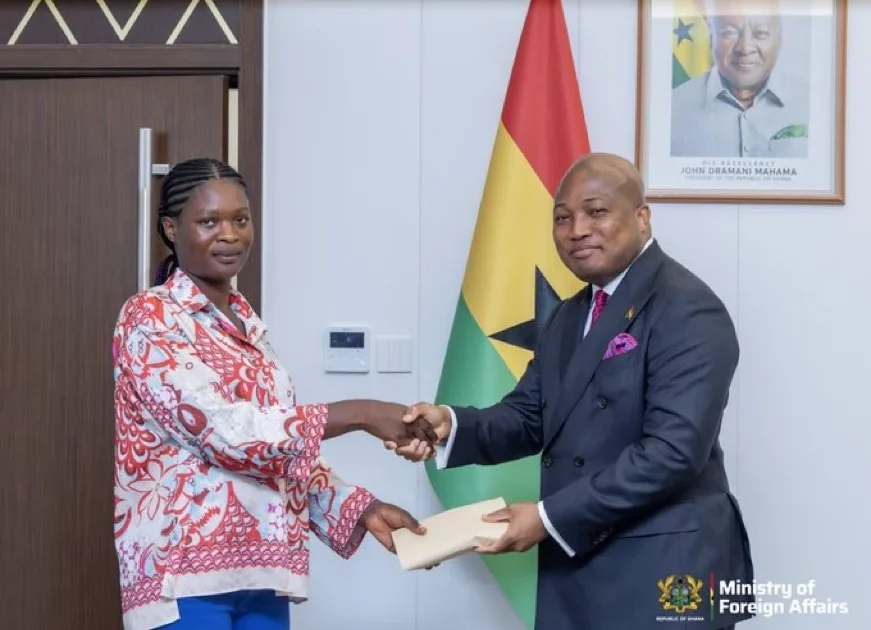
The Ghanaian government has confirmed the return of a domestic worker seen being physically assaulted in a viral video from Iraq, saying she escaped her attackers with help from her family, as it formally protests to Iraqi authorities and considers suspending the recruitment of domestic workers to the country.
Ghana’s Foreign Affairs Minister, Samuel Okudzeto Ablakwa, disclosed this on Tuesday after meeting the woman, Stephanie Nkrumah, and her family on Monday, November 23, following her return to Ghana.
In a statement shared on his X account, Ablakwa said the government had formally protested to Iraqi authorities, demanding appropriate action against those responsible.
“Glad to disclose that we found our compatriot in that awfully distressing viral video from Iraq,” he said.
He described the footage as showing Nkrumah being subjected to a “violent and dehumanising assault” by her employer.
The video, which circulated widely on social media in November, showed a man physically attacking a woman inside a room, pushing and hitting her while she sat on a chair and continuing the assault as she moved towards a wall.
Speaking in an interview with TV3 Ghana, Nkrumah identified the man who assaulted her in the footage as an agent of the recruitment agency that brought her to Iraq.
She also recounted how she was threatened with a gun and forced to return to the house where she worked as a domestic worker.
“They even pointed a gun at me at some point,” she said.
Explaining how the abuse affected her health, she said the beatings caused complications, but her employers failed to take her to a hospital for proper medical attention.
“The person who assaulted me in the viral video was an agent of the agency that brought me to Iraq. They pointed a gun at me and forced me to return to the house where I worked as a househelp.
“The beatings I suffered in the house caused health complications, but instead of taking me to the hospital, they always consulted a doctor.
“I was once given medication to take for 30 days before being told that I was not supposed to take it,” she said.
Meanwhile, Ablakwa said Nkrumah had escaped from her attackers and returned to Ghana with assistance from her family, who live in Kumawu in the Ashanti Region.
He said government officials listened to her account and encouraged her to provide details of those responsible and their network to support diplomatic efforts to secure justice.
“We listened carefully to her narrate her ordeal and encouraged her to share with us details of her abusers and their network to assist us in our diplomatic efforts for justice,” he stated.
The minister also disclosed that the government was considering a moratorium on the recruitment of domestic workers to Iraq, expressing concern that the incident might not be isolated.
“Government is strongly considering placing a moratorium on recruitment of domestic workers to Iraq as this does not appear to be an isolated incident,” he said.
Ablakwa further announced medical, psychological and financial assistance for Nkrumah following her return.
He said the government was providing free urgent medical care and clinical psychological support based on doctors’ recommendations after assessing her condition.
The minister also disclosed that he had donated GH¢50,000 to her as initial assistance towards establishing a small business.
He pledged to provide her with a scholarship to enable her to resume her formal education, which she discontinued a few years ago.
Reaffirming the government’s commitment to protecting Ghanaians abroad, Ablakwa said the Ministry of Foreign Affairs and its diplomatic missions would continue to prioritise the welfare and dignity of citizens living outside the country.
“As I keep insisting, an attack on any Ghanaian out there, is an attack on all of us,” he said.
He assured Nkrumah of the government’s support in her pursuit of justice and recovery.
