

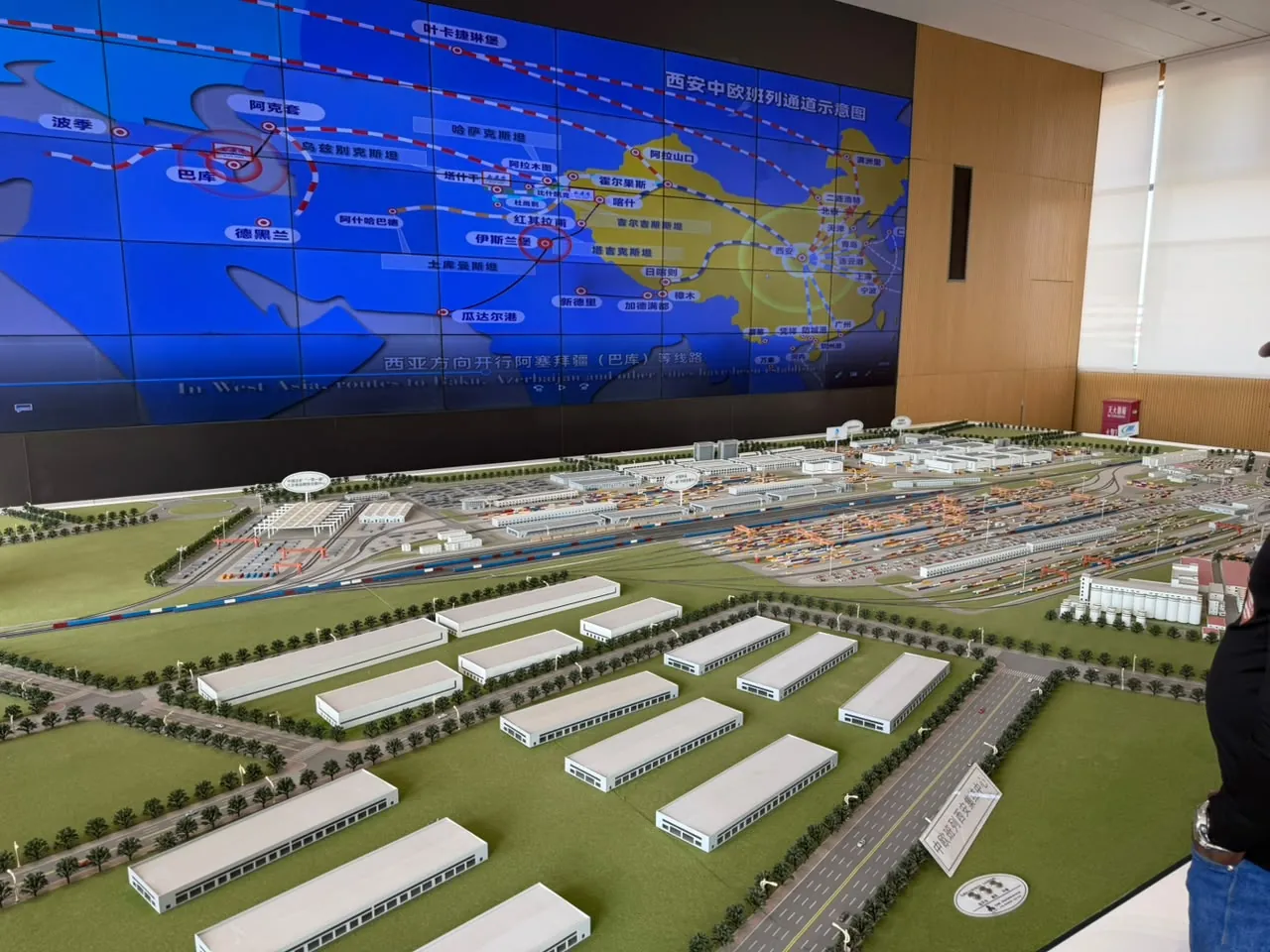
Standing at the Xi’an International Port Station in northwest China, watching the movement of freight trains preparing to transport goods across borders and continents, I was reminded that economic development is not only about what a country produces. It is also about how efficiently it can move what it produces to the rest of the world.
Xi’an occupies an interesting place in China’s history. It was once the starting point of the ancient Silk Road, which connected China to Central Asia, the Middle East and Europe through centuries of trade and cultural exchange. Today, the city is reclaiming that historic role through a modern railway network that connects Chinese manufacturing centres to markets across Europe and Asia.
The China-Europe Railway Express is one of the most visible outcomes of China’s Belt and Road Initiative (BRI). Through this network, freight trains transport automobiles, electronics, machinery, textiles, agricultural products and other goods across the Eurasian continent.
What makes the initiative particularly interesting is how it has transformed the economic possibilities of a city located thousands of kilometres from the sea. Xi’an has become an important international logistics hub, demonstrating that geographical distance from a coastline does not have to limit a city’s participation in global trade.
The railway network has continued to expand. By November 2025, China-Europe freight trains had completed nearly 120,000 journeys, connecting 232 cities in 26 European countries and more than 100 cities in 11 Asian countries. The value of goods transported through the network had reached $426.4 billion by the end of 2024.
These are not merely impressive transportation figures. They represent an evolving system of economic connectivity, linking manufacturers, suppliers, distributors and consumers across national borders.
Beyond transportation: The economics of connectivity
The significance of the railway goes beyond moving containers from one destination to another. It creates opportunities for businesses to reach markets faster, diversify their supply chains and reduce their dependence on a single transportation route.
Rail freight offers an important middle ground between air and sea transportation. While it is generally more expensive than shipping by sea, it can be considerably faster. For certain categories of goods, particularly machinery, automobile components, electronics and other time-sensitive products, that difference can be commercially significant.
It also provides an alternative when disruptions affect other transportation routes.
Another important feature is the development of inland logistics infrastructure. Warehousing, customs processing, container handling, industrial parks and distribution services have grown around railway connections. This means the economic benefits are not confined to the railway operators. They extend to businesses, workers and communities along the routes.
This is an important lesson in China’s approach to infrastructure: transportation infrastructure is being connected to manufacturing, commerce and international trade.
What does this mean for Africa?
At first glance, one might wonder how a railway connecting China to Europe has any direct relevance to Africa. After all, China and Africa are separated by thousands of kilometres of land and sea, and maritime shipping remains the principal channel for trade between them.
But the relevance of the China-Europe Railway Express to Africa is not necessarily that African countries should be connected to the same railway. It is the broader economic thinking behind it.
China’s approach demonstrates the value of integrating transportation, logistics, industrial development and international markets. Africa needs to pay attention to this model.
For African countries, better connectivity could transform the movement of goods within the continent, improve access to international markets and strengthen regional trade.
Imagine agricultural produce from northern Nigeria moving efficiently by rail to processing centres, industrial zones and seaports for export. Imagine manufacturers in Kano, Kaduna, Aba and other commercial centres having reliable connections to ports and distribution networks, reducing the cost and time involved in moving their products.
This is where railway development, inland dry ports, modern seaports and efficient customs systems become important.

Africa also has opportunities to improve its trade relationship with China. Rather than relying predominantly on importing finished products, African countries should seek stronger partnerships that support local manufacturing, agricultural processing, technology transfer and the export of value-added products.
For instance, Nigeria could explore more structured arrangements for exporting processed agricultural commodities, solid minerals and manufactured products to Chinese markets. Such opportunities would require investment in production capacity, quality standards, certification and reliable logistics.
The benefits of connectivity should also be reciprocal. It should not simply make it easier to bring more imported goods into African markets. It should make it equally possible for African businesses to compete internationally.
Nigeria must look beyond building railways
For Nigeria, perhaps the most important lesson from Xi’an is that building railway lines alone is not enough. The real value comes from connecting them to an integrated economic system.
Nigeria has made investments in railway infrastructure, including standard-gauge projects, and has strategic seaports in Lagos and other coastal locations. However, the challenge is ensuring that these assets work together.
Our industrial and agricultural production centres need efficient connections to railway terminals, inland container depots, dry ports and seaports. Customs procedures must become more efficient, while logistics operators should be able to track and move cargo seamlessly.
There is also a need to develop industrial and export-processing clusters around strategic transportation corridors. This would allow goods to be processed, packaged, stored and prepared for export closer to where they are produced.
The opportunity extends beyond Nigeria. Through the African Continental Free Trade Area, better transport and logistics networks could help businesses reach markets across the continent, rather than depending almost entirely on overseas destinations.
A partnership Africa must approach strategically
China’s Belt and Road Initiative presents opportunities for Africa, particularly in infrastructure development, logistics, industrialisation and trade. But African countries must approach these opportunities with clear economic priorities.
Infrastructure investments must be commercially viable, transparently negotiated and linked to productive economic activities. They should create local employment, strengthen domestic capacity and support sustainable development.
The objective should not simply be to build infrastructure, but to ensure that infrastructure generates economic value long after its construction.
China has demonstrated how a railway can become more than a transportation corridor. It can become an economic corridor connecting production, investment, trade and international cooperation.
My visit to Xi’an International Port Station offered a practical illustration of this thinking. It was a reminder that in today’s global economy, competitiveness is not determined only by what a country has beneath its soil or produces in its factories. It is also determined by how effectively it connects those resources and products to the world.
Africa has the resources, the population, the markets and the entrepreneurial capacity. What it needs is a more integrated approach to infrastructure and trade.
The future of Africa-China cooperation should therefore be about more than ships carrying containers between our ports. It should be about building the systems, partnerships and productive capacity that allow both sides to trade, manufacture, invest and grow together.
UPDATE NEWS:
Nigerians can now invest ₦2.5 million on premium domains and profit about ₦17-₦25 million. All earnings paid in US Dollars. Rather than wonder,
click here to find out how it works.
