

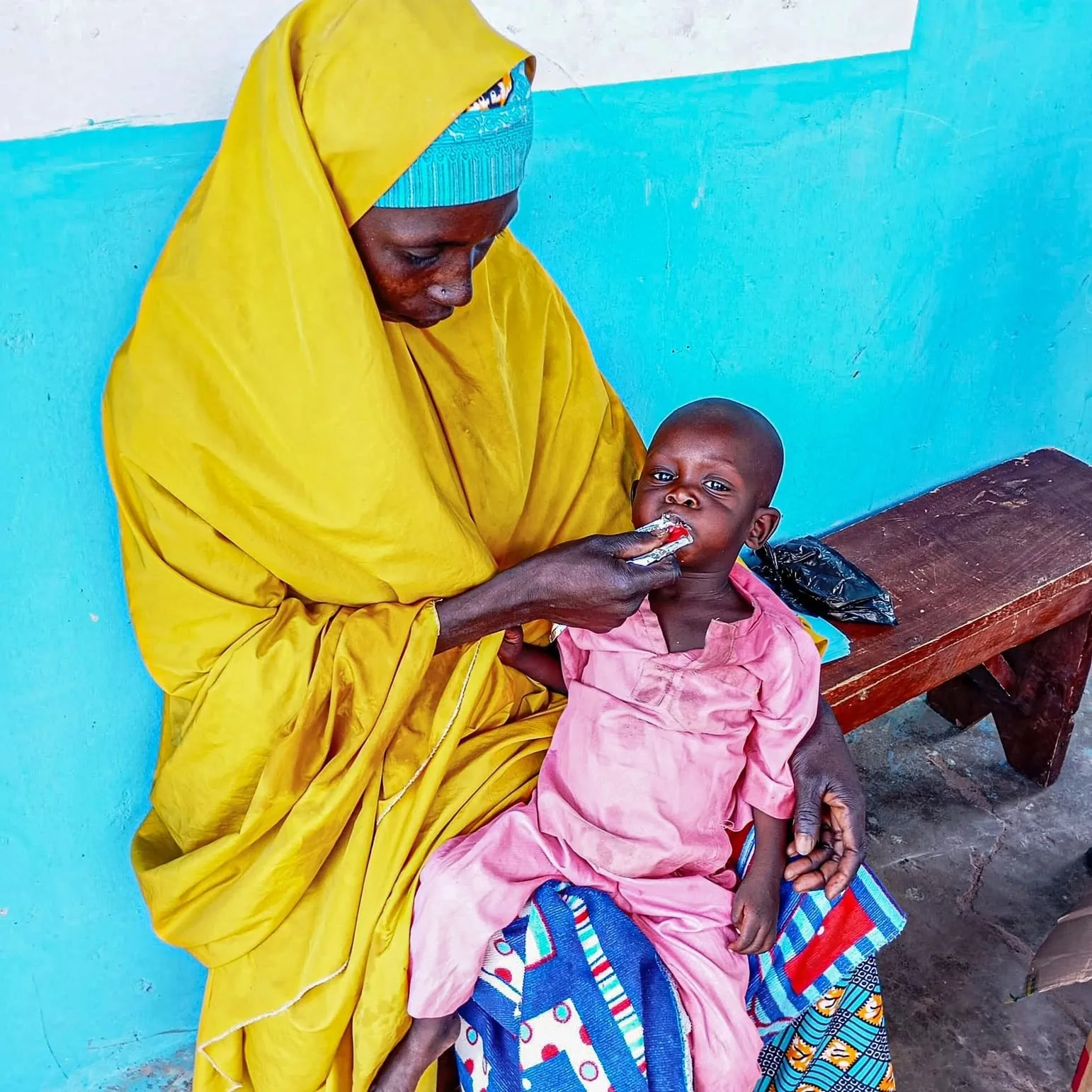
When Amina Bukar took in her 16-month-old nephew, Modu Mustapha, after the death of his biological mother, she faced a difficult responsibility. The little boy was severely malnourished, weak and in urgent need of care.
His mother had died after giving birth to him, leaving Amina, her sister, to take over his upbringing. But providing food and care for a child in such a condition was not easy.
For Amina, the fear of losing him was real. She needed help, and that help eventually came through nutritional support and healthcare services provided under the Multisectoral Integrated Nutrition Action Project (MINA), implemented by UNICEF and its partners.
Today, she says, Modu has regained strength and is doing much better.
“I sincerely appreciate the free provision of ready-to-use therapeutic food as it has greatly contributed to my child’s recovery. When I took him in after his biological mother passed away, he was severely malnourished and caring for him was difficult.
“But through the support of the MINA project, he has regained his strength and is now doing much better. I am truly grateful for this intervention,” she said.
Modu is among children in Yobe State whose experiences illustrate the importance of identifying malnutrition early and ensuring that affected children receive appropriate treatment.
For Fatima Bana, the experience was equally frightening. Her 20-month-old son, Adamu Bukar, had battled severe acute malnutrition, leaving her worried that he might not survive.
She recalled how his condition deteriorated before he received nutritional support and care.
“I am deeply grateful to God that my son has recovered from malnutrition. At some point, I feared I might lose him because of how severely his condition had deteriorated.
“It was a painful and frightening experience for me as a mother, but today, seeing him healthy, strong and doing well again fills my heart with joy and gratitude,” she said.
Across communities in Yobe, such experiences reflect the burden malnutrition places on families, particularly those already struggling with insecurity, displacement, economic hardship and limited access to nutritious food.
The prolonged crisis in the North-East has disrupted livelihoods and food production, leaving many households with difficulties providing balanced meals for their children. Children under five are particularly vulnerable to the consequences.
To address the problem, UNICEF is implementing MINA to strengthen nutrition services, promote early identification and support the treatment of children suffering from malnutrition.
However, the experiences of affected families show that access to treatment is only one part of the challenge. The availability of nutritious food, caregivers’ knowledge and the ability to recognise danger signs also determine whether children receive help early enough.
Grandmothers and mothers on the frontline
In some households, the responsibility of caring for malnourished children has fallen on women who are not their biological mothers.
Aishatu Umar, for instance, is being cared for by her grandmother, Yagana Musa, after her mother reportedly abandoned her and refused to breastfeed her because of prevailing beliefs.
Yagana said she had to travel to Gombe before taking responsibility for the child. On returning to Damaturu, she sought assistance from a man identified as Muhammad Bukar, who directed her to a health facility in Dikumari village, Damaturu Local Government Area.
There, Aishatu began receiving medical attention and ready-to-use therapeutic food (RUTF).
“Honestly, the girl is recuperating because, at the initial stage, nobody would agree that she would survive the severity of malnutrition. But now things are going smoothly.
“When I complain about her condition, they give us medicine free of charge. The hospital has been supportive to us,” Yagana said.
Her experience highlights the role of family members and community support in ensuring that vulnerable children are not left without care.
It also points to the influence of traditional beliefs and misconceptions on infant feeding and the response to childhood malnutrition.
Mrs Zubaida Ahmed, Nutrition Focal Person for Damaturu Local Government Area, said community awareness was necessary to address beliefs that sometimes prevent families from seeking appropriate treatment.
She said some people wrongly associate malnutrition with evil eyes or supernatural causes, whereas it is a condition linked to inadequate nutrients in the body and can be treated.
“We need to provide more awareness to these women that this is not something the mother did. It is not an evil eye. It is not an evil doing.
“This is malnutrition. It is about something that the body needs but the body was not able to get. We tell them that this condition is curable. It is not something that once a child has it, the child will die,” she said.
Ahmed said the local government was also encouraging positive household practices, including personal hygiene, appropriate feeding, antenatal care and early initiation of breastfeeding.
She stressed the importance of exclusive breastfeeding during the first six months of a child’s life, explaining that babies should not be given water or other foods during that period.
The struggle to reach treatment
For some families, reaching a health facility is itself a major challenge.
Mamman Musa travelled more than five kilometres to the Women and Children’s Hospital, also known as the Family Support Hospital, in Damaturu, to seek treatment for his son, Musa.
He said the child had developed fever, diarrhoea, vomiting and noticeable weight loss. The family initially tried local medication, but his condition continued to deteriorate.
Their community leader, Lamido Gako, eventually informed them about the hospital.
“We had never seen that type of sickness before. He had a fever, but not the type we were familiar with. He was losing weight and had diarrhoea, vomiting and fever. His condition kept worsening. Sometimes we went to bed thinking he would not survive the night.
“We were very upset and worried. We treated him with local medicine, but it did not work. Our community leader told us about this hospital, so we brought him here. To us, his recovery has been quick,” he said.
Musa said the difference in his son’s condition had become noticeable and that the child was now cheerful and able to eat the food given to him.
He added that health workers had taught the family how to use a measurement tape to check whether a child might be malnourished, a skill he said would help them monitor the child’s condition after returning home.
Another mother, Wasila Ali, said she initially struggled to understand what was wrong with her 22-month-old daughter, Maryam Isa Muhammad.
She noticed that the child had a high temperature and diarrhoea, and later began losing weight. After trying traditional medication without improvement, she took her to a nearby hospital.
According to her, the child was referred to a facility known as Gidan Madara for further treatment and therapeutic milk.
“When I brought her here, she could not even speak. Her mouth was full of sores. I was very worried and scared because I did not think she would survive.
“But we got help through the ready-to-use therapeutic food and she survived. Here she is now. She is healthy again and playful,” Wasila said.
The accounts of these families demonstrate the importance of referral systems and accessible treatment facilities, particularly for households that may not immediately recognise the signs of severe malnutrition.
Why treatment must go with nutrition education
At the Women and Children’s Hospital in Damaturu, Habibu Adamu, the nutrition in-charge and coordinator of Community-based Management of Acute Malnutrition activities under the Outpatient Therapeutic Programme (OTP), explained that children with severe and moderate acute malnutrition receive attention through the facility.
He said caregivers bring children for weekly visits to receive nutritional supplies and have their progress monitored.
According to him, children usually remain under the programme for between eight and 12 weeks, depending on their condition and response to treatment.
Adamu said the facility attends to between 50 and 60 children daily, describing ready-to-use therapeutic food as the backbone of its outpatient treatment programme.
“The backbone of OTP is the ready-to-use therapeutic food. Without RUTF, we can only counsel the mothers on how to prepare food at home and other things. But RUTF is the backbone of that OTP site,” he said.
He warned that malnutrition could affect a child’s physical growth and development, including cognitive development, while making the child more vulnerable to diseases.
Adamu recalled a case involving an eight-month-old child whose condition was so severe that he feared the baby might not survive.
He said he followed up with the mother at home after providing RUTF, and the child subsequently improved.
The account underscores the importance of follow-up beyond the health facility, particularly where caregivers need support to administer treatment and monitor their children’s recovery.
But health workers say treatment must be accompanied by education that enables families to prevent malnutrition from recurring.
Making nutritious food part of household life
Dr. Nwogu Kelechukwu, UNICEF Nutrition Specialist, said insecurity and economic hardship had left some families unable to provide adequate food for their children.
He explained that UNICEF and its partners were supporting families through nutrition education, awareness campaigns and counselling on how to prepare nutritious meals using locally available foods.
According to him, the objective is to encourage sustainable household practices rather than make families depend entirely on emergency interventions.
He said some households sell nutritious foods such as eggs and chicken without setting aside enough for children’s consumption, while children are sometimes given meals that do not provide the nutrients required for healthy growth.
“We want women to be able to give their children food that contains different groups of food: carbohydrates, proteins, dairy products and things that will supply the micronutrients children need to grow healthy,” he said.
Nwogu also encouraged families to establish homestead, kitchen or backyard gardens where they could grow fresh leafy vegetables for household consumption.
He said such gardens could help families access nutritious ingredients and improve children’s diets even when household incomes were limited.
The message is particularly important for families whose economic circumstances make it difficult to purchase a wide variety of food.
For Ahmed, the Damaturu nutrition focal person, changing feeding practices also requires sustained engagement with mothers, caregivers and other household members.
She said families were being encouraged to adopt positive behaviours around hygiene, feeding, care for pregnant women and breastfeeding.
Beyond recovery
The stories of Adamu, Modu, Aishatu, Maryam and Musa show how timely treatment and the commitment of caregivers can change the course of a child’s life.
But their experiences also reveal the broader challenges confronting families: poverty, food insecurity, harmful beliefs, limited awareness and the difficulty of reaching health services.
Dr. Nwogu Kelechukwu said the MINA project had treated more than 200,000 children and delivered more than five million doses of vitamin A under the programme.
He added that the project had counselled more than 700,000 women, approaching 800,000, to help them identify signs of malnutrition and take appropriate action.
“Our aim is to prevent malnutrition, but we already have children who are malnourished. We have been able to treat more than 200,000 children under the MINA project to ensure that these children do not die. We have delivered more than five million doses of vitamin A to children under the project, and we have counselled more than 700,000, close to 800,000 women.
“So women are able to check their own children on a weekly basis. From the information given to them, they are able to refer them or take appropriate action. We need to improve positive behaviours,” he said.
These programme figures point to the scale of intervention, but sustaining progress will require continued access to treatment, reliable nutrition supplies, community-level screening and stronger household feeding practices.
For caregivers such as Amina and Yagana, the immediate priority is that the children entrusted to them survive and grow healthy.
Their experiences show that the fight against child malnutrition does not end when a child leaves a treatment centre. It continues in the home, where caregivers must have the knowledge, resources and support to provide adequate nutrition.
For Yobe’s vulnerable children, recovery is a beginning. Ensuring that they remain healthy will depend on whether the support they receive in health facilities can be sustained in their homes and communities.
UPDATE NEWS:
Nigerians can now invest ₦2.5 million on premium domains and profit about ₦17-₦25 million. All earnings paid in US Dollars. Rather than wonder,
click here to find out how it works.
