

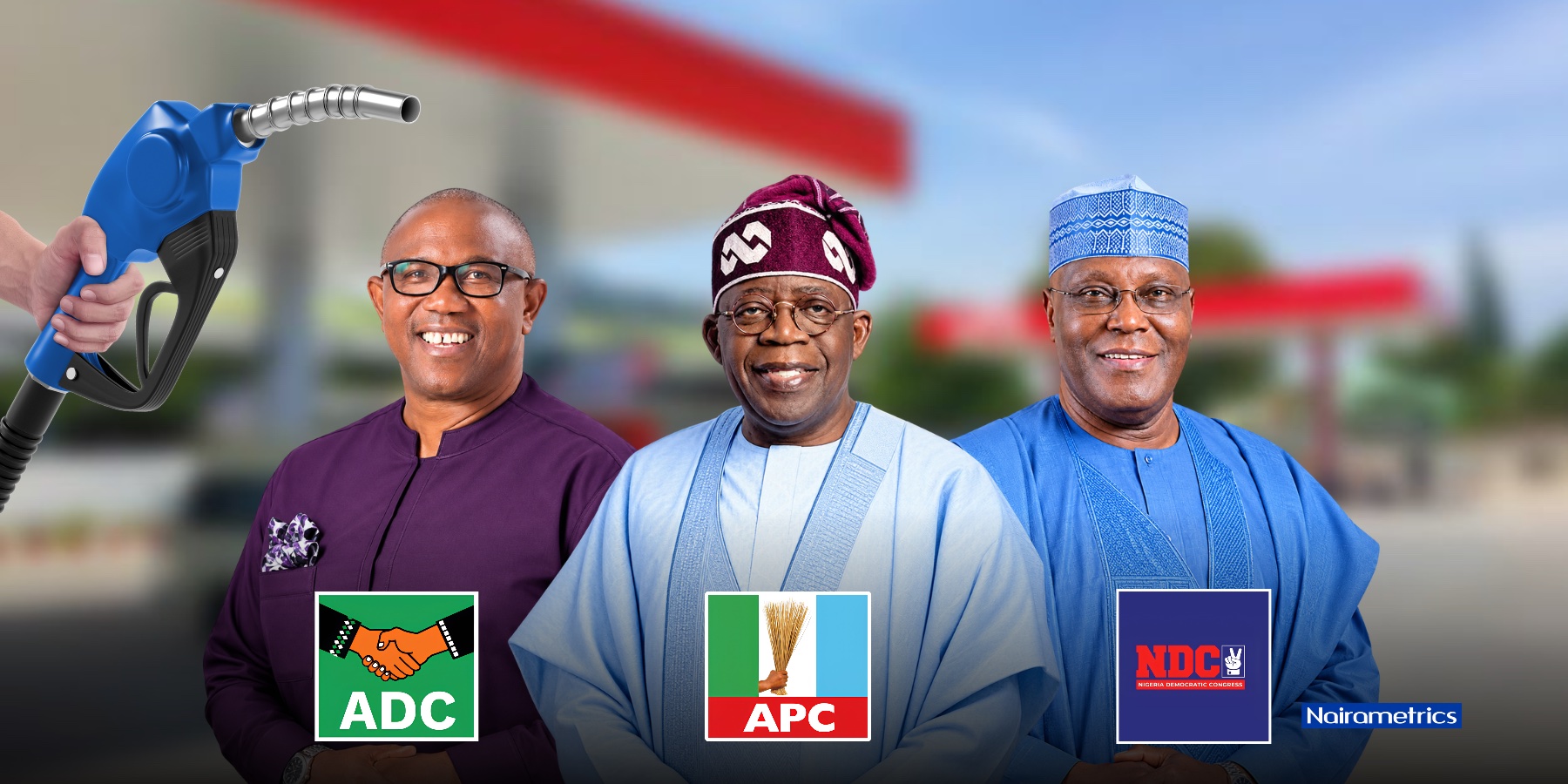
Three years after President Bola Tinubu announced the removal of petrol subsidy, the policy remains a major point of disagreement among Nigeria’s leading presidential contenders for the 2027 elections, with Atiku Abubakar promising to restore targeted subsidies, Peter Obi advocating a more gradual and transparent approach, and the incumbent defending the decision as necessary for economic recovery.
The competing positions come as the Federal Government introduces a petrol price ceiling of N1,350 per litre on the ex-gantry or landing cost of petrol, a mechanism designed to moderate domestic price increases without formally returning to the subsidy regime.
The development has added another dimension to the debate over petrol pricing, government intervention and the cost of living, raising questions about whether Nigeria can sustain a deregulated petroleum market while protecting consumers from sharp price fluctuations.
For voters, the issue is increasingly about more than the fiscal benefits of subsidy removal. It also concerns how presidential candidates intend to balance government spending, market efficiency and the purchasing power of households.
Atiku promises targeted fuel subsidy restoration
Former Vice President and the presidential candidate of the African Democratic Congress (ADC) Atiku Abubakar, who previously supported the removal of fuel subsidy, has indicated that he would restore a targeted subsidy if elected president in 2027.
In a post on his X account, Atiku said his position was informed by the need to protect Nigerians from the rising cost of living associated with higher petrol prices.
- “On the question of subsidy, my position has not changed and will not change: I will restore it! A nation as blessed as ours has no business abandoning its citizens to hardship,” he stated.
He argued that Nigeria had the resources to provide targeted support to citizens, particularly as increases in petrol prices feed into transportation costs, food prices and household expenditure.
- “When fuel rises, transport rises. When transport rises, food rises. When food rises, families suffer,” he added.
Atiku’s position suggests a return to some form of government support for petrol consumers, although his emphasis on targeted subsidy indicates that he is not necessarily proposing a restoration of the previous universal subsidy arrangement.
The former vice president has not, however, provided detailed information on how such a programme would be funded, the beneficiaries it would cover or the mechanism for preventing the corruption and fiscal leakages associated with the previous subsidy regime.
Peter Obi questions implementation, advocates phased removal
The presidential candidate of Nigeria Democratic Congress (NDC), Peter Obi, has also criticised the Tinubu administration’s approach to subsidy removal, although his position differs in important respects from Atiku’s.
Obi, who previously supported the removal of fuel subsidy, has maintained that his objection is to the manner and timing of the implementation rather than the need to address the problems associated with the subsidy system.
In a post on X, he described the announcement by Tinubu on May 29, 2023, as careless, arguing that the government failed to undertake adequate consultations or assess the potential consequences for the economy and ordinary Nigerians.
- “As Nigerians will recall, President Bola Tinubu on May 29, 2023, most carelessly removed fuel subsidy without any consultation or proper assessment of the negative impacts of such policies on our economy particularly on the livelihood of ordinary Nigerians,” Obi stated.
He has argued that the government should first have addressed corruption within the subsidy system, established the actual cost of the intervention and developed a carefully planned, phased removal programme.
Obi also insists that savings from subsidy removal should have been transparently invested in critical sectors, including agriculture, healthcare, education, poverty reduction and security.
In subsequent media engagements, including an interview with the BBC, Obi reiterated that he would tackle corruption associated with the subsidy regime while restoring fuel subsidy.
His position therefore centres on combining targeted government support with stronger accountability and a more gradual transition away from the previous system.
Tinubu defends subsidy removal, cites N15.8 trillion savings
President Tinubu has consistently defended the removal of fuel subsidy, arguing that the policy was necessary to prevent further deterioration of government finances and free up resources for development.
In his inaugural address on May 29, 2023, Tinubu declared that “fuel subsidy is gone”, effectively ending a decades-long government intervention that had kept petrol prices below market-reflective levels.
The decision triggered a sharp increase in petrol prices, with knock-on effects on transportation, food prices, manufacturing and the broader cost of living.
However, the administration has maintained that the fiscal benefits outweigh the costs of retaining the previous arrangement.
Tinubu recently reiterated that subsidy removal saved Nigeria from imminent bankruptcy and provided a foundation for gradual economic recovery.
The Minister of Finance, Taiwo Oyedele, has also put the government’s estimated savings from subsidy removal at N15.8 trillion.
At the subnational level, governors have acknowledged the additional resources available to states through increased allocations from the Federation Account Allocation Committee (FAAC).
Imo State Governor Hope Uzodinma, for instance, described the removal as a direct blessing to subnational governments, noting that more resources were now flowing to states.
However, the increased allocations have not eliminated concerns over the effect of higher petrol prices on household purchasing power, particularly among low-income earners.
Government introduces N1,350 petrol price ceiling
Despite repeatedly ruling out a return to the old subsidy regime, the Federal Government has introduced a petrol price ceiling mechanism intended to moderate the impact of fluctuations in international crude oil prices and foreign exchange rates on domestic petrol prices.
Speaking at a briefing in October, Oyedele disclosed that the government was negotiating a ceiling of N1,350 per litre on the ex-gantry or landing cost of petrol.
Under the proposed arrangement, where the cost exceeds the agreed ceiling, refiners and importers would initially absorb the difference and recover it later when market conditions improve.
Oyedele maintained that the mechanism was neither a subsidy nor conventional price control, but a price-smoothing arrangement designed to prevent domestic petrol prices from responding immediately to every movement in global crude oil prices or exchange rates.
He also indicated that the arrangement would be reviewed monthly.
The mechanism effectively introduces a form of intervention into a market the government has repeatedly described as deregulated.
It also raises questions about how refiners and importers will recover deferred costs, the implications for their cash flows and whether the arrangement can remain sustainable if crude oil prices or exchange rates remain unfavourable for an extended period.
