

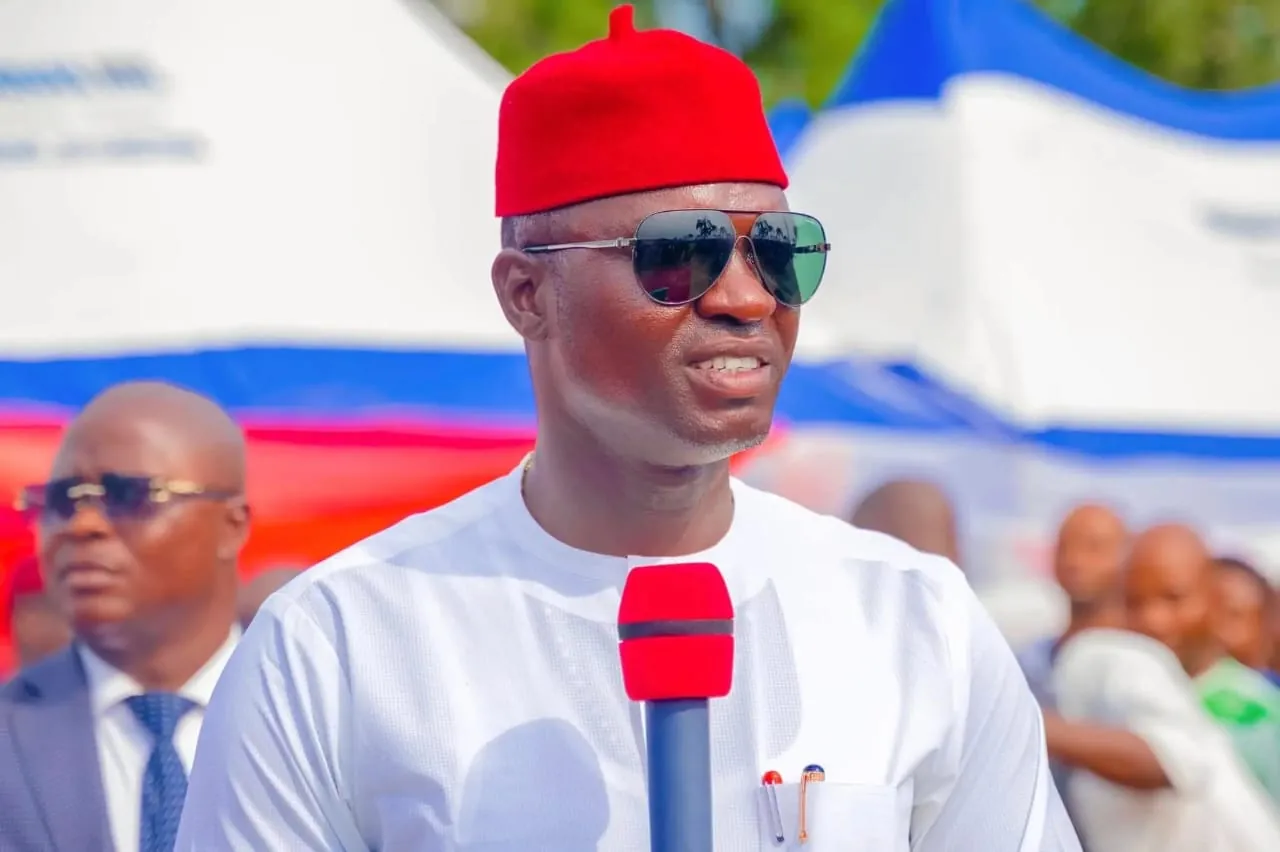
Governor Francis Nwifuru of Ebonyi State has threatened to persecute residents of Amasiri community if they fail to vote for his re-election.
He warned that those who oppose him at the polls would face persecution.
The governor issued the threat while addressing members of the community in Afikpo North Local Government Area of Ebonyi State during a recent campaign rally.
Nwifuru, in a video of the address, said he was no longer inclined to show mercy to those he considered opponents.
He insisted that rejecting him electorally would amount to persecution against him.
“Let me tell you, I know how I’ll do it. If you think I’m hoping on you, I’m not hoping on you. I know how I’ll do it, it will be like a film to you,” he said.
“What I want to tell you is that the days of mercy are gone. Now, if anyone pokes our mouth, we will finish them.”
The governor, who invoked God in describing his emergence as leader, said he was prepared to remain in power.
He warned the community against voting against him.
“God gave us the leadership position and gave us the strength to be leaders and we shall be leaders in the name of Jesus,” he said.
Nwifuru, however, said he had no intention of persecuting the community unless its members acted against him.
“I have nothing with which to persecute the Amasiri people, but if you persecute me, I will persecute you.
“If you don’t vote for me, you have persecuted me and that is when you will really see what is persecution,” he added.
The governor expressed confidence in his electoral prospects, declaring that he would win the forthcoming election.
“On whether I will win, I will definitely win,” he said.
Nwifuru’s threat comes against a backdrop of mounting concerns over increasingly combative and intimidating political rhetoric by public officials and party leaders as preparations for the 2027 general elections gather momentum.
In recent months, several serving politicians have been criticised for remarks threatening voters, opposition supporters and residents who do not align with their political interests.
In Ebonyi itself, Nwifuru had, in September, warned newly sworn-in local government chairmen that he would remove those whose councils failed to deliver electoral victories for the All Progressives Congress in 2027.
He reportedly told them that councillors would be used to effect their removal.
APC chieftains have been caught in similar controversies, with the public calling on authorities to caution them.
In August, Borno State Commissioner for Youth and Sports Development, Sainna Buba, threatened people who opposed the party.
He warned that their fingers could be broken and that those who refused to support the APC would be flogged.
The remarks, made at an event organised by the Tinubu City Boy Movement, a support group campaigning for President Bola Tinubu’s re-election, attracted widespread criticism, including calls for an investigation by Amnesty International.
Buba subsequently apologised and withdrew the remarks.
Also in August, Chairman of Kuje Area Council in the Federal Capital Territory, Samuel Danjuma Shekwolo, stirred controversy after telling residents that they either supported the APC or left the council.
The remarks drew condemnation from the National Human Rights Commission, which called for an investigation, while Shekwolo later said he had no intention of disenfranchising residents.
In Edo State, Esan West Local Government Chairman, Blessing Ebhodaghe, was also reported to have threatened commercial drivers over the display of opposition party materials.
The council boss reportedly directed them to wear APC-branded caps or risk losing access to the motor parks.
The directive was linked to efforts to mobilise votes for President Tinubu ahead of 2027.
The controversies have extended beyond threats against voters and residents to inflammatory remarks against opposition supporters.
In August, Senator Francis Fadahunsi, representing Osun East, was criticised over a video in which he was alleged to have called for the killing of members of the Accord Party ahead of the Osun governorship election.
He later said his remarks were intended to mean defeating the opposition politically, rather than physically harming its members.
The police reportedly investigated the comments, which also attracted calls for prosecution.
In Kebbi State, Gwandu Local Government Chairman, Atiku Ahmad Mandiya, was also quoted as urging supporters to deal with anyone who spoke against Governor Nasir Idris.
The recurring incidents have prompted warnings from electoral authorities, police and civic organisations about the consequences of intimidation and inflammatory political speech.
INEC Chairman, Joash Amupitan, has cautioned political actors against turning campaigns into theatres of violence.
The police have also warned that inciting statements and threats capable of undermining public peace could attract criminal investigation and prosecution.
Nigeria’s electoral laws prohibit the use of force or threats to compel voters to support or reject a candidate or political party.
UPDATE NEWS:
Nigerians can now invest ₦2.5 million on premium domains and profit about ₦17-₦25 million. All earnings paid in US Dollars. Rather than wonder,
click here to find out how it works.
