

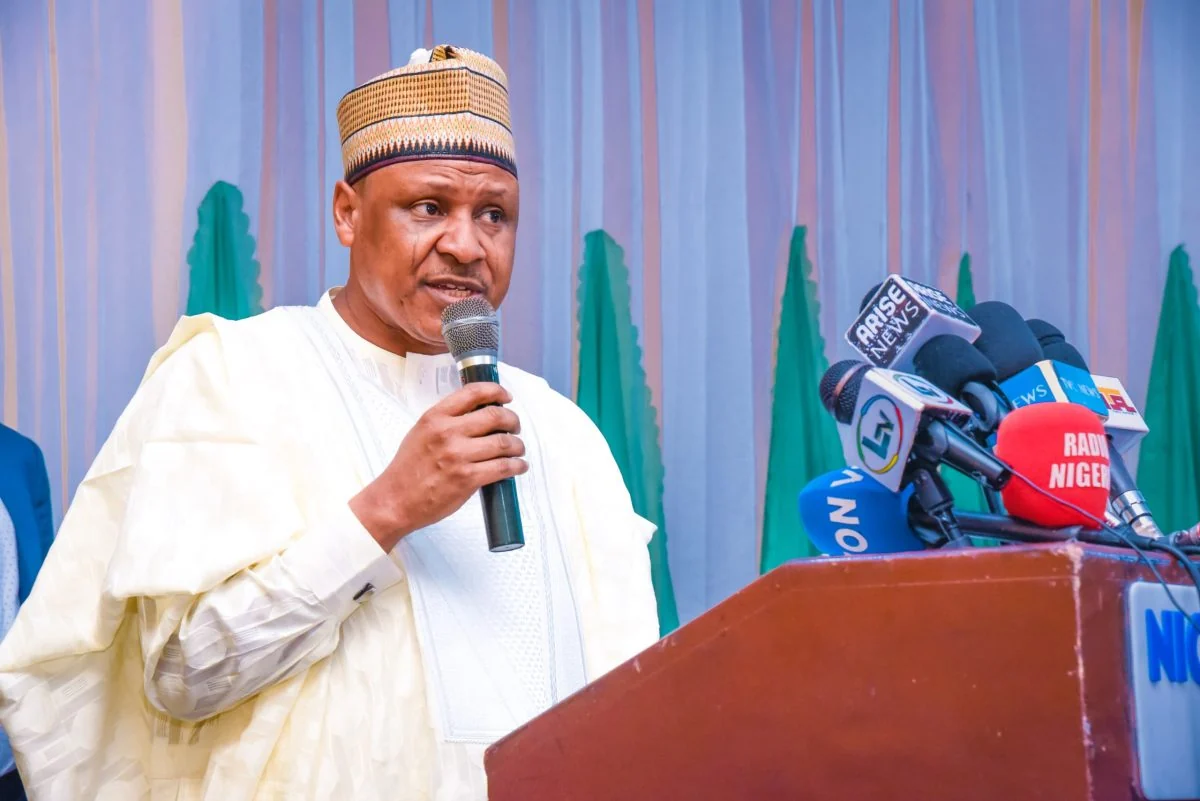
MINISTER of Information and National Orientation, Mohammed Idris, has pointed to the stabilisation of Nigeria’s foreign exchange regime and the expanding Compressed Natural Gas (CNG) programme as clear signs that the country is making tangible progress under President Bola Tinubu’s administration.
Speaking at a media briefing in Lagos, Idris said the chaotic multiple exchange-rate system that defined previous decades had been largely dismantled. “For 40 years we’ve been trying to do that and not doing it,” he said. “We forgot so easily that we had a messy foreign exchange regime in this country. Planners, newsprint people, nobody knew how to plan. The rates you got in the morning were different from the one you got in the afternoon and the one you got in the evening.”
The minister argued that the current unified and more predictable exchange-rate environment has restored planning capacity for businesses and government, something he described as fundamentally different from the past.
He linked this stability to broader reforms that have improved Nigeria’s standing with international financial institutions. Fitch, Moody’s and S&P assessments have improved, and the Financial Action Task Force delisted Nigeria from its grey list in the last quarter of 2025, he noted.
On energy and transport costs, Idris and Special Adviser to the President on Media and Publicity Bayo Onanuga both emphasised gains in the CNG sector.
Idris said that for the first time in the country’s modern history, a serious national push toward CNG conversion is underway, with more than 400 conversion centres already operational.
“In 300 years, when did we have that?” he asked.
Onanuga provided further details. He said the Presidential CNG Initiative has converted commercial vehicles and created an enabling environment that has attracted about $2.5 billion in private investment into the CNG market. More fuelling stations are opening, and vehicle conversions continue. Dangote’s entire fleet, he noted, already runs on CNG despite the company producing petrol.
“On Saturday, the President announced in Ibadan that a Chinese bus manufacturer, Yukon, is coming to Nigeria and is supplying by December 100 CNG buses,” Onanuga said.
According to him, assembly of CNG buses and electric vehicles is also planned. Several states have taken the initiative: some have ordered 50 buses each, Kaduna has deployed about 2,200 buses (many of them CNG) that residents can use free of charge, while Borno is rolling out electric vehicles and motorcycles.
Onanuga stressed that the removal of the fuel subsidy had freed resources for states to invest in infrastructure and public transport. He acknowledged that fuel prices remain high partly because of global tensions involving Iran, but said market forces and the growing CNG alternative should ease pressure over time.
“The president is committed to ensuring cheaper, cleaner mode of fuelling our buses,” he said.
Idris insisted that these developments — exchange-rate predictability, CNG expansion, improved security corridors, road rehabilitation, and health infrastructure — demonstrate that Nigeria is “on the march” even if it has not yet reached its desired destination. “If we say that things are not happening, I tend to disagree,” he said. “Look at where we were only a few years ago and where we are now.”
WATCH TOP VIDEOS FROM NIGERIAN TRIBUNE TV
