

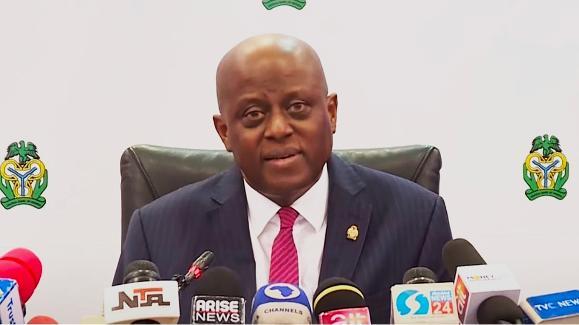
Nigeria has called for equity, fairness and proportional representation in the governance structure of the proposed Economic Community of West African States (ECOWAS) Monetary Union, arguing that countries making larger financial contributions should have a corresponding voice in decision-making.
Olayemi Cardoso, governor of the Central Bank of Nigeria (CBN), said regional solidarity and the sovereign equality of member states must be balanced against their respective financial commitments, responsibilities and risks in establishing the proposed ECO single currency.
Cardoso made the call on Friday, November 20, 2026, while speaking on behalf of Nigeria at the Ministerial Session of the sixth Presidential Task Force Meeting on the ECOWAS Single Currency Programme in Abidjan, Côte d’Ivoire.
The meeting, which brought together finance ministers and central bank governors of member states represented on the Presidential Task Force, focused on accelerating preparations for the phased introduction of the proposed single currency from 2027.
Cardoso described the meeting as a defining milestone in the region’s monetary integration process, noting that discussions had increasingly focused on the institutional architecture of the proposed Monetary Union.
These include the location of the union’s institutions, leadership appointments, and the allocation of authority and responsibilities among participating countries.
He warned that decisions on these arrangements would have far-reaching implications for the credibility, legitimacy and long-term sustainability of the proposed monetary union.
“The decisions we take today will shape the future of the Union for decades to come,” Cardoso told delegates.
He said the decisions would influence the confidence of investors and development partners, the legitimacy of the institutions among citizens and the willingness of member states to sustain their commitments.
According to him, countries’ financial obligations must be matched by meaningful participation in the institutions they are helping to establish.
The CBN governor reaffirmed Nigeria’s longstanding commitment to the ECOWAS Monetary Cooperation Programme and the establishment of the ECO, citing the country’s substantial financial contributions, sustained technical support and compromises made in the broader interest of regional consensus.
He, however, maintained that regional solidarity should not come at the expense of equitable representation, particularly for countries carrying greater financial responsibilities and systemic risks.
“While bigger economies continue to take up the burden, they should also be considered to play a significant role because of the risk and systemic importance they have in the sub-region,” he said.
Cardoso said countries making substantial contributions to the proposed union would also need to justify those commitments before their respective parliaments and civil society.
He warned that an arrangement in which financial obligations were shared without corresponding influence in governance could undermine the long-term sustainability of the monetary union.
“Where obligations are shared but influence is not, arrangements may be agreed, but their long-term sustainability may be difficult to guarantee,” he added.
The governor stressed that Nigeria’s position was not driven by a desire for dominance or entitlement but by the responsibility associated with its status as West Africa’s largest economy and one of the principal contributors to the proposed monetary union.
He noted that Nigeria would commit substantial financial resources, reserves and institutional capital to the success of the project, making it reasonable for responsibility, accountability and participation in governance to reflect the scale of those commitments.
Cardoso also urged delegates to approach the discussions with openness, mutual respect and a willingness to compromise, expressing confidence that member states could reach a balanced agreement.
He emphasised that every participating country must have a tangible stake in the success of the proposed union, warning against a situation in which any member state bears significant obligations without an appropriate voice in its governance.
Nigeria’s position comes as ECOWAS intensifies efforts to advance the institutional and governance arrangements required for the proposed ECO single currency, with the phased introduction targeted for 2027.
The latest deliberations underscore the importance of resolving questions surrounding institutional leadership, decision-making authority and the distribution of responsibilities before the monetary union is established.
The proposed ECO is part of ECOWAS’s broader monetary integration agenda, which seeks to deepen regional economic cooperation and establish a common currency among member states.
For Nigeria, Cardoso said, the success of the initiative would depend not only on regional solidarity and shared commitments but also on a governance framework that ensures fairness, accountability and meaningful representation for all participating countries.

Hope Moses-Ashike is an Associate Editor, Banking and Finance, with more than a decade of experience reporting on Nigeria’s financial system and broader economy. She closely tracks market movements, monetary policy decisions, company disclosures, regulatory actions, economic indicators, and global developments, and interprets what they mean for businesses, investors, policymakers, and households. Her reporting helps readers understand complex issues such as inflation trends, foreign exchange market dynamics, interest rate decisions, bank performance, and investment risks.
She also covers major international events and periodically travels to Washington, D.C., to report on the World Bank/IMF Spring and Annual Meetings.
Her dedication to financial journalism has earned her multiple recognitions and invitations to high-level professional development programmes. She is an alumna of the International Visitors Leadership Programme (IVLP) in the United States and holds an Advanced Financial Journalism Certificate from the Press Association Training in London, UK. Her other notable achievements include completing the Lagos Business School CMC Programme, the Bloomberg Media Africa Initiative Programme, and a Master Class in Journalism at Rhodes University in South Africa.


