

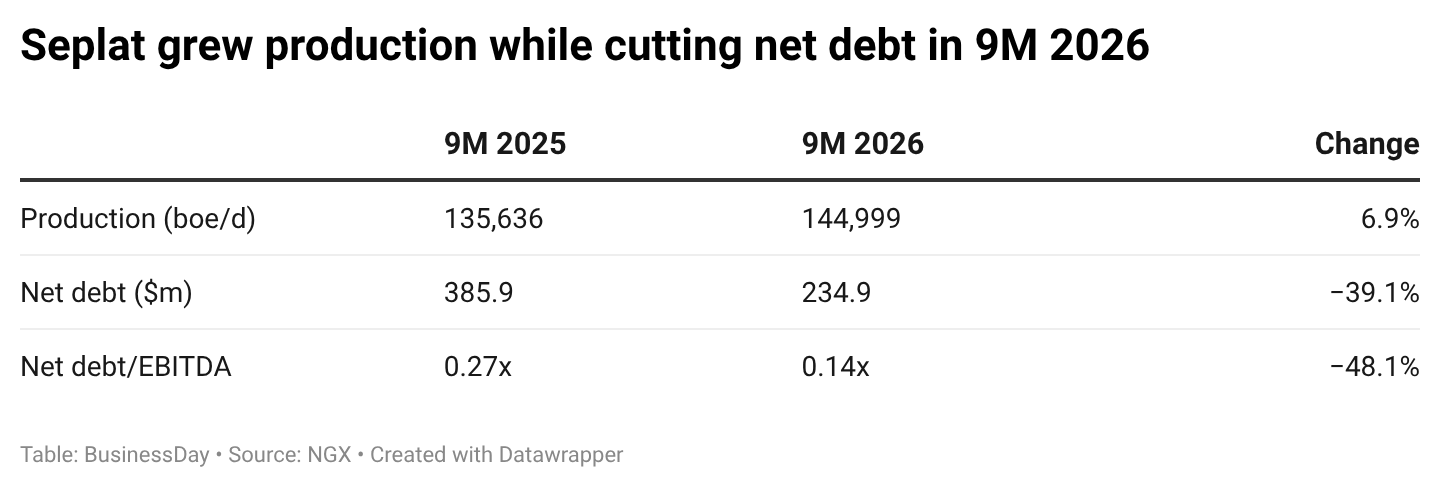
Seplat Energy’s profit after tax rose 2.7 times to $260.2 million in the first nine months of 2026, as higher realised oil prices and improved production strengthened earnings, with CardinalStone Research projecting further growth despite regulatory and portfolio changes that could moderate its longer-term outlook.
CardinalStone said Seplat’s performance reflected improved operational efficiency and stronger commodity prices. The company recorded an average realised oil price of $96.19 per barrel in the nine months, about 9 percent above the Brent benchmark average of $88.22 per barrel.
The research firm attributed the production improvement partly to the integration of wells from Seplat’s 2025 drilling programme and its 2026 idle-well restoration initiative.
The programme had restored 41 of the 50 wells planned for the year by September, adding more than 64,000 barrels of oil equivalent per day in gross production capacity.
CardinalStone expects Seplat’s average group production to reach 147,000 barrels of oil equivalent per day in 2026, implying 11.8 percent year-on-year growth in working-interest volumes. It also raised its full-year revenue forecast to about $4.01 billion, representing a 47.1 percent increase from 2025.
The outlook is supported by higher expected oil, gas and natural gas liquids prices, as well as stronger onshore
production following increased contributions from the ANOH gas project.
Seplat reported its first commercial gas sales through the OB3 pipeline, while the resumption of activities on the Trans Forcados Pipeline is expected to support onshore output.
However, offshore production remains exposed to delays in restoring output from Yoho and the temporary suspension of commercial gas sales following a leak on the Oso-BRT pipeline.
CardinalStone expects repairs to support the restoration of production in the fourth quarter.
The research firm also highlighted the planned sale of a 10 percent working interest in the NNPCL-SEPNU joint venture for approximately $281.6 million.
The transaction will reduce Seplat’s interest in the venture from 40 percent to 30 percent, while lowering its previous 2030 production target from 200,000 to 170,000 barrels of oil equivalent per day.
A separate concern is the delay in converting Seplat’s offshore assets to the Petroleum Industry Act framework.
Following regulatory engagement, the Nigerian Upstream Petroleum Regulatory Commission indicated that the original conversion window had elapsed.
CardinalStone consequently raised its forecast average effective tax rate to about 64 percent over the next five years, from 54 percent previously.
Despite these constraints, the research firm expects net income to grow at a compound annual rate of 4.9 percent between 2026 and 2031, supported by improved hydrocarbon monetisation, cost optimisation and resilient free cash flows.
Seplat’s balance sheet has also strengthened following repayment of the $200 million Advanced Payment Facility in the first half of 2026 and the remaining $100 million in October, completing repayment of debt associated with the MPNU acquisition.
CardinalStone expects net debt to EBITDA to fall to 0.1 times in 2026 from 0.5 times in 2025.
The firm raised its 12-month target price to N17,588.87 from N16,454.41, implying 8.3 percent upside from its N16,241.90 reference price, while retaining a Hold recommendation.


