

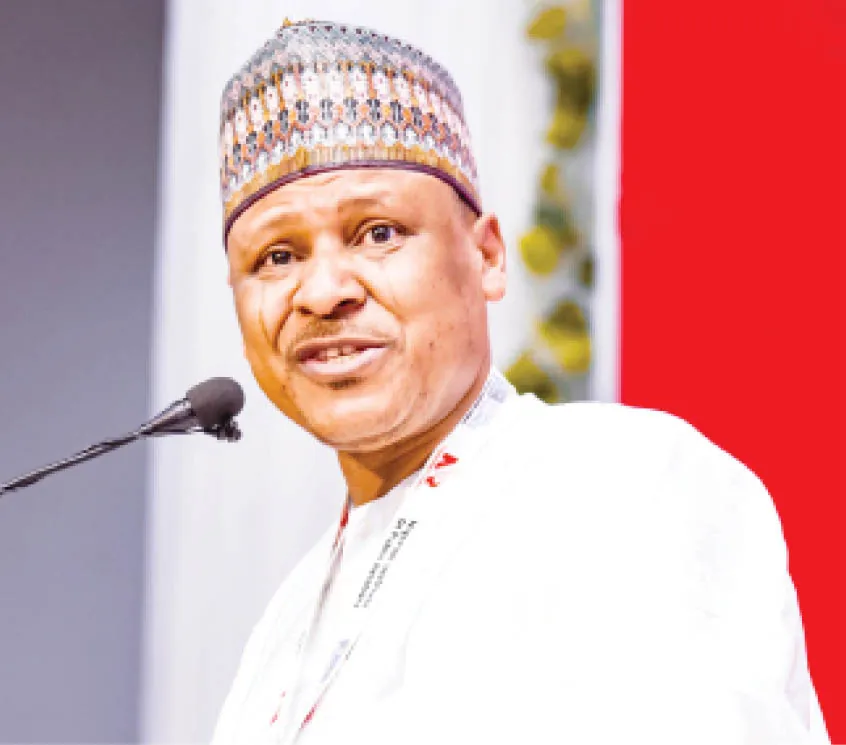
The Minister of Information and National Orientation, Mohammed Idris, has defended President Bola Tinubu’s economic and governance policies, arguing that his administration has taken difficult but necessary decisions that previous governments avoided for decades.
Idris said the Tinubu administration was different from its predecessors in its approach to foreign exchange management, security coordination, infrastructure development, agriculture, power sector reforms and the removal of the petrol subsidy.
The minister, who spoke while responding to questions on the administration’s performance during an interactive session in Lagos, said Nigeria had struggled with structural economic problems for about 40 years because successive governments failed to address fundamental weaknesses in the economy.
He cited the foreign exchange market as one of the areas where the President had demonstrated political courage, noting that the previous multiple exchange rate system created uncertainty for businesses and investors.
“For 40 years, we’ve been trying to do that and not do it. We forgot so easily that we had a messy foreign exchange regime in this country. Planners, newsprint people, nobody knew how to plan. The rate you got in the morning was different from the one you got in the afternoon and the one you got in the evening,” Idris said.
He argued that the administration’s foreign exchange reforms had helped address distortions that made economic planning difficult, although he acknowledged that the country still had significant challenges to overcome.
On security, the minister said improved coordination among the military services had contributed to gains recorded in tackling insurgency and other security threats.
He said collaboration among the Chief of Army Staff, Chief of Air Staff and other security agencies had improved under the current administration, resulting in better coordination of operations.
Idris recalled that Boko Haram had previously controlled several local government areas in Borno State, stressing that the situation had changed significantly.
He also cited improvements along the Kaduna-Abuja road corridor, which he said was previously notorious for killings and kidnappings.
According to him, travelling by road along the route has become considerably safer, pointing to the recent APC rally in Kaduna, which attracted participants who travelled from Abuja without reported security incidents.
He said the improvement demonstrated that the government’s security interventions were producing results, even though more work remained to be done.
On infrastructure, Idris highlighted the administration’s road development programme, particularly the rehabilitation and reconstruction of existing highways across the country.
He disclosed that about 2,700 kilometres of roads were being addressed across different parts of Nigeria, in addition to new road projects like the Lagos-Calabar, among others.
The minister specifically mentioned projects in Niger State, describing the state as strategically located at the centre of the country and important to national connectivity.
He argued that the administration’s infrastructure programme was not concentrated in Lagos or a few major cities but extended to different regions, including the North-East.
On agriculture, Idris said the President was committing N450 billion to support the sector, describing the intervention as part of efforts to strengthen food production and improve national economic resilience.
He also pointed to the government’s power sector reforms, describing them as unprecedented, although he admitted that electricity supply remained below expectations because of years of infrastructure neglect.
Using the broadcasting sector as an example, he recalled visiting Radio Nigeria Kaduna and other government-owned media facilities after assuming office.
He said some of the equipment still in use dated back several decades, illustrating the extent of deterioration in public infrastructure and the need for sustained investment.
Special Adviser on Information and Strategy to the President, Bayo Onanuga, also defended the removal of petrol subsidy, insisting that reversing the policy would undermine investments in the downstream petroleum sector and return the country to an unsustainable fiscal arrangement.
He explained that the subsidy burden had placed enormous pressure on government finances, with the Nigerian National Petroleum Company Limited facing difficulties meeting its obligations to suppliers.
According to him, the government had accumulated about $6 billion in obligations to suppliers at the time, while the national oil company struggled to finance the subsidy arrangement.
Onanuga said the situation made it difficult for the government to sustain the policy without borrowing or diverting resources from other critical sectors.
He also rejected suggestions that the government should impose price controls on petroleum products, arguing that such intervention could undermine the economics of private investment in refining.
He warned that reversing the subsidy policy or introducing measures that distort market pricing could damage the refining industry and discourage investors, including Nigerians who had invested in companies such as Dangote Refinery.
“If you bring some of this back, you are going to ruin the industry. You will ruin it. All your investment will go, those of you who have bought shares,” he said.
Onanuga further argued that the government had provided alternative energy options through initiatives promoting compressed natural gas (CNG) and electric vehicles.
He said electric vehicles were being brought into the country without certain import duties and charges, as part of efforts to encourage cleaner and potentially cheaper transportation alternatives.
UPDATE NEWS:
Nigerians can now invest ₦2.5 million on premium domains and profit about ₦17-₦25 million. All earnings paid in US Dollars. Rather than wonder,
click here to find out how it works.
