

Starting an investment is an important financial decision, but it is not the end of the process. Unfortunately, many people treat it that way.
They open an investment account, purchase a financial product, commit to a savings or investment plan and then move on to other responsibilities. Months pass, sometimes years, without checking whether the investment is performing as expected, whether the original objective is still relevant or whether their financial circumstances have changed.
For some, the only time they remember an investment is when they need money.
This approach can create problems because financial goals, market conditions, personal responsibilities and investment needs do not remain constant.
As another financial year approaches, individuals who have already started saving and investing should make portfolio review an important part of their financial routine.
An investment portfolio should grow with your financial life.
Imagine someone who started investing five years ago to fund a child’s university education. At the time, the child was three years old, and the investment horizon was approximately fifteen years.
Today, the child is eight. The original objective remains, but the time available to achieve it has reduced. The investor should therefore examine whether the contributions, investment strategy and expected future value remain sufficient.
Similarly, someone who started investing towards retirement at age 30 will have different considerations at age 45. Their income, family responsibilities, retirement timeline and tolerance for investment risk may have changed.
An annual review provides an opportunity to determine whether the investment remains aligned with the objective.
What exactly should you review?
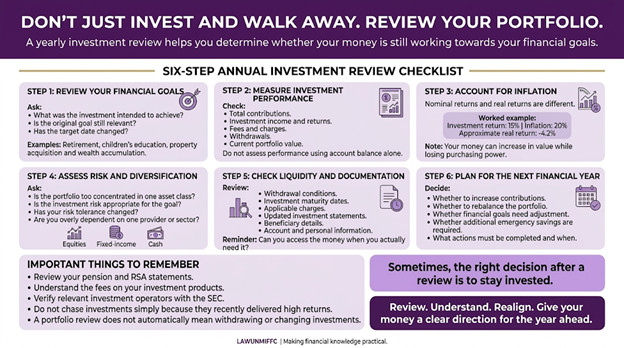
The first step is to revisit the reason you invested in the first place.
List your financial goals and the investments connected to them. These may include retirement, children’s education, buying property, business expansion or long-term wealth accumulation.
Next, examine the performance of each investment. Do not simply look at the current balance. Compare the amount contributed, income earned, fees and charges, withdrawals and current value.
Where applicable, assess the investment’s performance against an appropriate benchmark and consider the effect of inflation.
For example, assume an investment produces a nominal return of 15 per cent over a year when inflation is 20 per cent. Although the account balance has increased, the investor’s purchasing power has declined. The approximate real return is negative 4.2 per cent, before considering taxes and fees.
This distinction matters because the amount of money in an account does not always tell you how much that money can buy.
The next consideration is risk.
Has the level of risk in your portfolio changed? Are you holding too much of your money in one asset class, sector or investment provider? Does the investment still match the period within which you need the money?
A person saving for a goal due in two years may not be able to take the same level of risk as someone investing for retirement over twenty years.
The purpose of a review is not necessarily to change investments. Sometimes, the best decision is to maintain an existing strategy. However, that decision should be informed rather than based on neglect.
Check whether your portfolio is still properly balanced.
Investments can become disproportionately concentrated over time. For example, a portfolio that originally contained a balanced mix of equities, fixed-income instruments and cash may become heavily weighted towards equities following a period of strong stock market performance.
Rebalancing may be necessary to bring the portfolio back in line with the investor’s intended asset allocation and risk tolerance.
This does not mean selling every investment that has performed well or buying every asset that has declined. Decisions should consider the investor’s objectives, investment horizon, transaction costs, taxes where applicable and the underlying reasons for the change in value.
Investors should also review the liquidity of their investments. How quickly can the money be accessed when needed? Are there withdrawal restrictions, penalties or maturity dates? Does the portfolio contain sufficient accessible funds for short-term obligations?
These questions matter because a portfolio can appear impressive on paper but become inconvenient when an investor needs cash.
Do not forget investments you rarely think about.
For Nigerians in the formal employment sector covered by the contributory pension arrangement, an annual review should include checking their Retirement Savings Account (RSA).
The National Pension Commission (PenCom) requires Pension Fund Administrators to issue RSA statements at least once every quarter. These statements should help contributors monitor their account balances, contributions and investment returns.
Employees should confirm that their pension contributions are being remitted and properly reflected. Where discrepancies arise, they should contact their PFA and follow the appropriate complaint channels.
Other investments, including mutual funds, treasury bills, bonds, shares and insurance-linked savings or investment plans, should also be reviewed according to their individual terms and objectives.
Investors should request updated statements, understand the charges applicable to their products and confirm the current status of their investments. For capital market products, they should also verify the registration of relevant operators with the SEC.
Prepare for the new financial year with clear decisions.
Once the review is complete, identify the adjustments required.
Perhaps your income has increased and you can raise your monthly investment contribution. Perhaps a child’s education expenses are approaching and you need to strengthen the education fund. You may also discover that you have several investments serving the same purpose while another important goal remains unfunded.
Write down the changes you intend to make, the amount involved and when each action should happen.
It is equally important to review your beneficiaries and personal information where applicable, update your financial records and ensure that relevant investment documents are accessible.
Above all, resist the temptation to change your entire portfolio simply because another investment product is currently attracting attention. Recent returns do not automatically predict future performance.
An annual review is not a competition to find the investment with the highest advertised return. It is an opportunity to establish whether your money is still working towards the life you intend to build.
Starting an investment is progress. Monitoring it, understanding it and making necessary adjustments are what turn that progress into a deliberate financial strategy.
Do not allow another financial year to pass without knowing what happened to the money you have already committed to your future.


